Introduction
Automotive manufacturers observed that charging and discharging in EV Batteries generates substantial amount of heat, and managing heat is very crucial in thermal management of the battery cells. Often, poor contact connection or uneven cooling within the battery packs can lead to the creation of hotspots, which degrade the life of the battery, and in some extreme cases, can lead to thermal runaway. Hence, the efficient performance of the battery pack, its safety, and durability depend on how the heat generated in the cells can be effectively managed.
Hence, this article provides a detailed comparison between thermal pads and thermal gels to facilitate in the choice of the right thermal material to be used for product design and production.
EV batteries
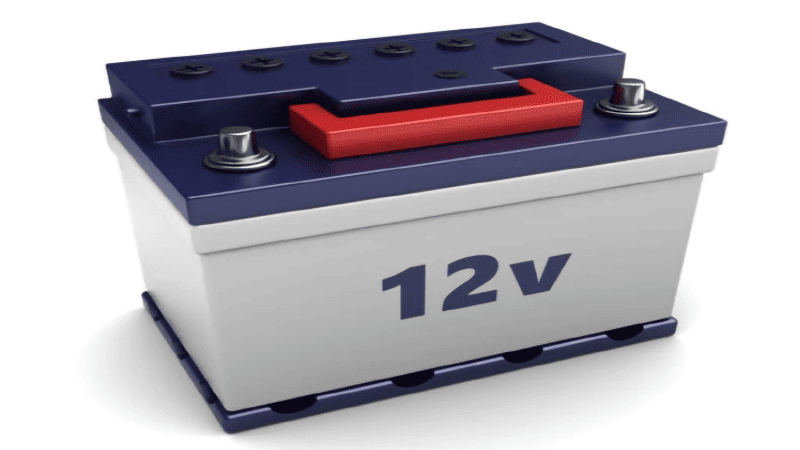
An electric vehicle battery is a rechargeable battery that is made up of lithium-ion and is designed to power heavy equipment with a high power-to-weight ratio and energy density. EV batteries are used to supply dv energy to the electric motor of a battery electric vehicle (BEV) or hybrid electric vehicle (HEV).
Research points out that gap fillers facilitate heat transfer more evenly across cells. Battery modules using high-compliance gap fillers, when compared to packs without effective gap fillers, show greater uniform temperature distribution profiles of about ±2 °C, 15–20% slower temperature rise rates (in an abusive condition where heat transfer is minimum), reduce thermal resistance in interface materials trim, and improve cycle life by about 30–50% longer. These experimental results were conducted under repeated charging and discharging of electric vehicle (EV) batteries.
Therefore, making the right selection of materials (thermal pads or thermal gels) can enhance heat dissipation and heat transfer between the cells of the battery pack and the cooling terminals.
Battery Packs
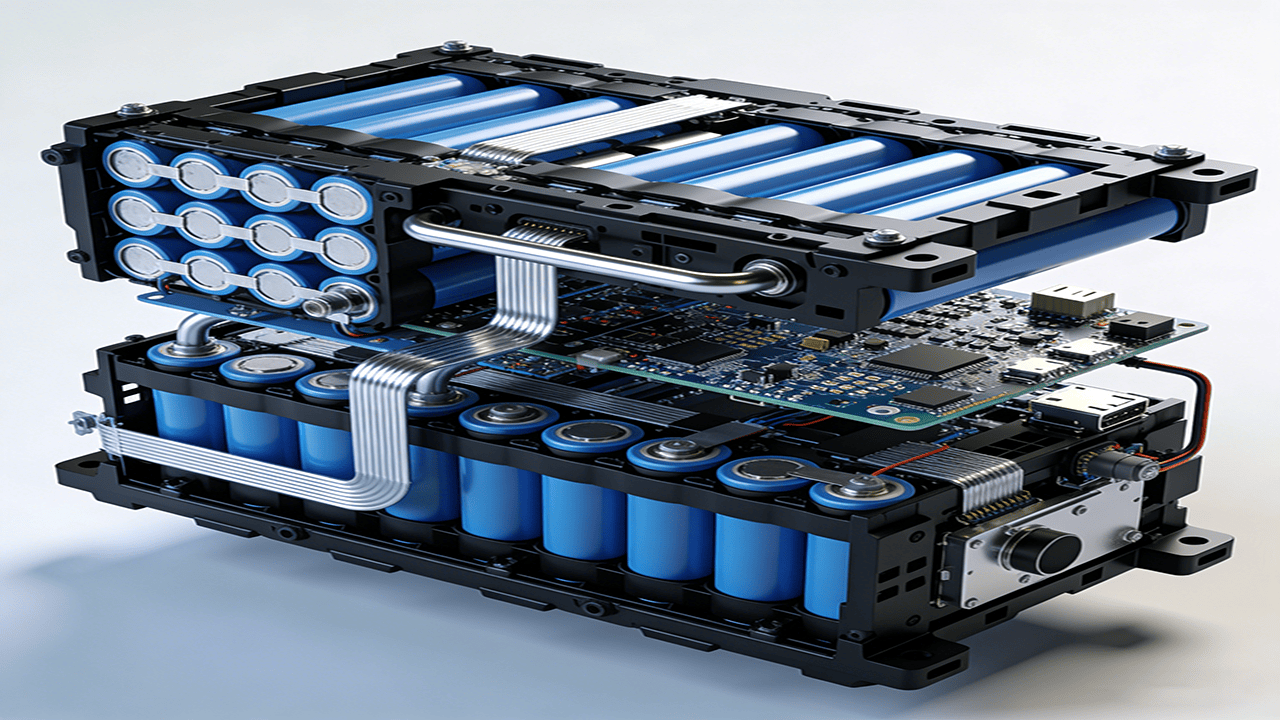
Battery packs are an energy storage system (ESS) that are critical components in EV vehicles and are designed to serve as a primary storage unit for providing electrical power to the entire system, ensuring its optimal performance. The energy is stored in various cylindrical cells connected to one another in the battery pack, as shown in the figure below. The packs consist of multiple cells that are connected in series and parallel to form a high-voltage battery, and it functions by converting the stored chemical energy into electrical energy. The technology behind this energy storing packs has drastically helped in the replacement of traditional internal combustion engines to battery electric vehicles (BEVs).
The use of TIMs is critical in EV batteries for the purpose of not exceeding their thermal requirements so as to facilitate ensuring their optimal performance and safety. These materials function by preventing overheating that could degrade the battery life between the components and the cooling system, as it is essential for maintaining the life and efficiency of the pack.
In battery production, microscopic air gaps are created to facilitate in the battery’s breathing and swelling, which constitute the thermal and mechanical properties of the cells. This breathing refers to the change that occur between the active components of the anode and cathode, causing internal mechanical stress within the cell to pack batteries, hence the need of improving thermal contacts of the cells. The swelling is a progressive increase in thickness due to aging-related side reactions, such as passivation layer growth and lithium plating, which increases the cell’s intrinsic stress. These phenomena are common in lithium-ion batteries.
Thermal interface materials are designed to manage these microscopic air gaps by filling the voids, hence, creating an efficient pathway for heat to flow between solid surfaces and other tims.

Thermal interface materials (TIMs), roles, and attributes
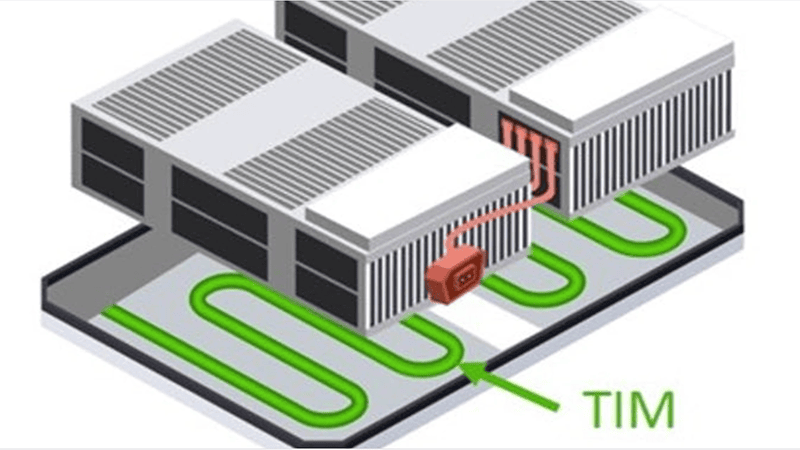
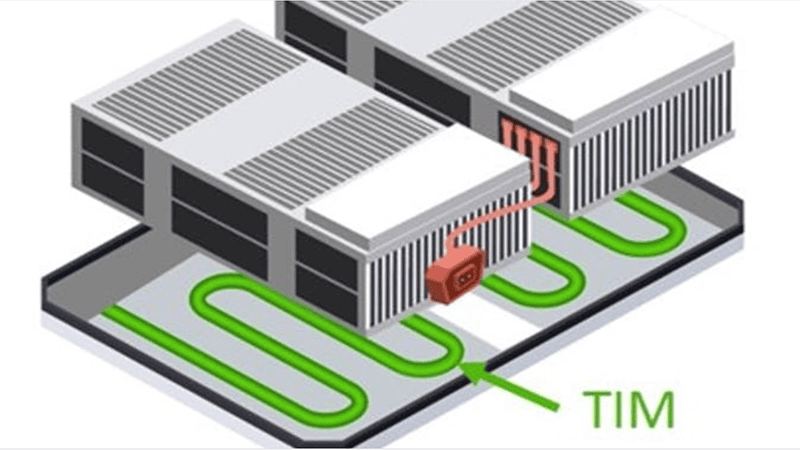
Thermal interface materials tims are materials placed between two solid surfaces. In EV batteries, these materials are normally placed between the outer surface of the battery cell and the cooling plate within the battery. This is done with the purpose of reducing interfacial thermal resistance through the filling of macroscopic and microscopic gaps.
Gaps exist between two surfaces because of production tolerances allotted to the cell, cooling plate, and assembly. Other conditions that create gaps includes the roughness of surface, cell swelling during cycling, and the deformation of the cooling plate. In EV battery systems, thermal interface materials link imperfect surfaces to improve heat distribution from cells to cooling assemblies and passive heat spreaders. These materials appear as conductive pads, gels (liquid or semi-liquid gap fillers), adhesives, phase-change materials, or greases.
Electromagnetic interference is reduced to a small amount in battery management systems when the use of conductive enclosures, specialized coatings, and strategic placement of components are employed as a solution to minimize EMI emission and susceptibility.
A workable thermal interface material is defined by few attributes. These attributes include the following:
- that the materials should possess a good thermal conductivity
- easy to apply,
- stable over a long period of time,
- have high resistance to gases and chemicals,
- and are made of non-combustible material.
What are Thermal pads and Thermal gels?
Thermal pads and gels are thermally conductive materials commonly used for filling of tiny gaps between a component and a heat sink for the purpose of effective heat transfer.
As aforementioned, TIM function by filling microscopic air gaps existing between heat sources and cooling structures. Since air has low heat conductivity, small voids can increase a significance amount of resistance. Using soft and conformable pads will ensure tight contact and enhance heat transfer efficiency.
Thermal pads
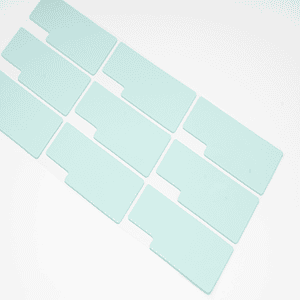
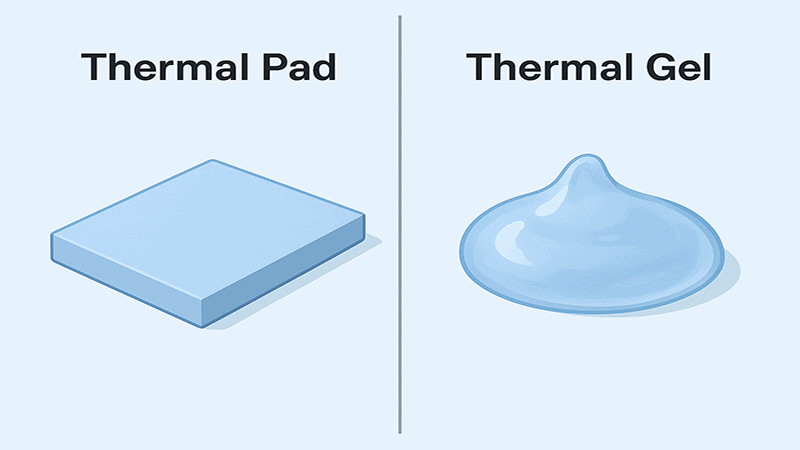
Thermal pads are solid intrinsic materials that are made from a combination of a silicone base with high thermal conductivity fillers such as ceramics and metallic particles. They are compressible to about 10–50% of their original thickness and are often used because of their thickness to bridge predictable gaps between components and heat sinks. They are compressed to reduce trapped air through the thermal contact created. Another reason why they are compressed is that they help to accommodate manufacturing tolerance and mechanical stress on the component.
Pads are easy to install (i.e., pick-and-place) as they are electrically insulating materials that provide good electrical insulation, which helps to prevent short circuits in electronic assemblies. They often find usage in automated manufacturing and are efficient in thermal management and heat dissipation.
Thermal paste
Thermal pastes or gels are also called liquid-dispense gap fillers or thermal encapsulation gel. Thermal gels are adaptable and softer as they are flowable or paste-like in description. When this thermal paste is used, they remain soft and conformal in the areas they are applied. They are also efficient in wetting, filling of micro-asperities, and conforming to variable gaps in areas where they are applied, resulting in reduced microscopic air pockets that increase thermal resistance. Some are classified as lightly curing silicones, and some as non-curing silicones. Generally, they are effective materials in managing heat.
Gap Fillers
Studies have it that fillers outperformed pads in terms of lowering heat resistance, as fillers conform to surface roughness perfectly. Fillers in EV batteries consist of four modules. This includes two water plates on the top and bottom of the module, with the void filler material separating the cooling contacts from the pouch cells and the chassis.
Voids fillers are critical in energy management of hot bodies for a number of reasons: They enhance electric insulation, provide vibration damping, and have the ability to enhance cooling between the cells and the contacts.
Thermal Conductivity
The value of a thermal conductivity for a typical thermal gel is between 2.0 W/m·K and 4.5 W/m·K. This range positions the gel between the standard thermal pads and premium thermal paste in terms of thermal conductivity. Laboratory testing of thermal gel confirmed that the effective thermal conductivity of gels in real time applications conform completely to the surfaces under investigation. Mathematically, Effective Thermal Performance is given by (X: Effective Thermal Performance = Thermal Conductivity × Thickness ÷ Contact Thermal Resistance. Hence, in scenarios with a small void (e.g. <0.3 mm), gels gives better solution in providing high compression and high surface fit. But when it comes to larger voids, a pad may be a better option as it will provide better structural support. Gels often suffer from drying issues or pump-out issues. In thermal pads, thermal conductivity is in a range between 1 and 20 W/m·K, depending on materials and quality.
Good Thermal Conductivity
Generally, thermal conductivity is measured in watts per meter-kelvin (W/m·K) and there are parameters that make materials to have a good thermal conductivity. These Materials as aforementioned can be in the form of pads, gels or pastes. A good thermal conductivity is hereby defined as a material used in electronics cooling which has an ability to efficiently transfer heat that is typically above 3 W/m·K.
Thermal Pads vs. Thermal Gels
| Feature | Thermal Gel | Thermal Pad |
|---|---|---|
| Application style | Thermal gel fillers are dispensed directly onto the surface and requires accurate control, typically using an automatic dispensing machine. It is more resilient and less likely to dry out compared to grease e.g. silicone free gap fillers. | Thermal pads are placed directly without requiring additional processing as they are cut to sizes making them easier to handle in certain applications. |
| Curing or solidification Procedures | The solidification procedures need a lot of time to be achieved. This is because it involves the use of heat or pressure. Thermal gels need time to dry in order to obtain optimal thermal conductivity as the process is only applicable to sealant such as RTV and silicone encapsulant. However, the vast majority of thermal pastes/gels are non-solid. | Thermal pads are produced for a ready for use application. therefore, they do not need drying since their application is simple in the assembly processes. |
| Thermal conductivity Performance | Since thermal gels has the ability to fill up microscopic air voids, it offers superior better conductivity performance in terms of temperature mitigation. | Thermal pads on the other hand provide lower thermal conductivity in terms of temperature mitigation. However, it is effectively used in other thermal management applications. |
| Cost consideration | Material selection is one of the parameters that determine cost. other parameters include installation, application time, and long-term reliability. In considering cost per unit, thermal gel or paste cost more due to its ability to last long for the period of approximately 7-10 years. This attribute makes gels to be cost-effective in many applications. | When comparing between thermal pads and gels in term of cost reduction, pads are cheaper in application than gels. |
Misconception between Thermal Pads and Thermal Gels
There are misconceptions that appears in literatures which negate the engineering facts about thermal pads and thermal gels. these confusions are identified and discussed below.
Thermally conductive Adhesive Properties
It was cited in most literature that the adhesive properties of thermal pastes provide a very strong bond after solidification, which makes it difficult to separate under thermal stress or vibration. However, this statement is a very strong misconception in engineering, and it is an error to accept the claim. Pastes/gels do not possess any structure, nor does it provide a strong bond. Vibration that exists in packs comes from structural design, compression force, and packaging method. Hence, most thermal pads, in contrast to gels, are usually non-adhesive and are very easy to replace. Few other have their sealant bonds but weaken over time due to exposure to extreme hot conditions, though they still retain their thermally conductive properties.
The classification of Thermal Conductivity grades is a false standard
It was cited in literatures that there is general electronics cooling rules that when a material’s range is below 1 W/m·K, it is considered Poor. Similarly, when a material is ranged from 1–3 W/m·K, it is named to have fair electronics cooling. 3–6 W/m·K is considered to have a good cooling ability. 6–10 W/m·K is considered to be very good and above 10 W/m·K is considered excellent. However, there is no recognized engineering standard with such a classification. Whether a thermal conductivity is good or not, it is highly dependent on the thickness and compression interface conditions. This is a marketing-style classification, not engineering common sense
Speed in heat removal
Heat is transferred from a hot surface to a cold surface in contact with each other through the process of conduction. The process to which this hot surfaces transferred this energy to pads and gels is through the Interface Thermal Resistance steady-state (ΔT). Hence, the misconception that speed in heat removal is faster with pads is an error as there is no such concept that pads conduct heat faster and gels conduct heat slower.
Performance Factors between Thermal Pads and Thermal Gels
Gap Filling Ability
Thermal pastes excel at filling irregular or uneven, rough surfaces that exist between temperature sources and sinks. They flow into the microscopic voids, providing optimal thermal contact. Thermal pads on the other hand comes in a pre-formed shape and have a limited ability to fill up highly irregular surfaces.
Ease of Use
Thermal pastes or gels requires precise mixing and application, but it is potentially more complex. Thermal pads are simple to use and suitable for mass production as they have precise application.
Tolerance to uneven surfaces
Thermal pastes are excellent when being used in rough surfaces. Thermal pads range from fair to poor when being used in rough or uneven surfaces.
Reworkability
Maintenance for reuse of thermal pastes is very low, whereas in pad maintenance for reuse is high. However, in some cases, it is recommended that thermal pads should not be reuse because during installation they were compressed during installation, and in removal, they easily got torn, or lose adhesion, which alters their shape and thickness, thereby reducing their thermal performance.
Cleanliness
when thermal pastes are applied, the area look messy after use. Whereas, when thermal pad is applied, the pack looks clean and tidy after used.
Other TIMs
TIMs regulate temperature across traction packs by effectively optimizing the process of heat transfer between key components to support its efficient dissipation. Aside the gels and pads as mentioned above, there are other tims that helps in the heat management.
Adhesive Tapes
These are tapes are double-side, and they function by bonding components together to facilitate efficient heat transfer while providing dielectric insulation and mechanical stability. They are widely use for attaching sensors, spreaders, or heaters, as they possess the ability to eliminate the need of fastening, hence maintain stable condition.
Thermal Barriers
These barriers are designed solution for Runaway Protection. Some packs’ designs incorporate insulative barriers, such as mica sheets, ceramic fibers, or aerogel mats, between cell groups to slow the spread of heat during faults. These barriers function by guiding the hot energy toward cooling channels and preventing undesired transfer between cells.
Pastes and greases
These materials fill microscopic air voids between tightly interfacing surfaces such as cells and cooling plates. They are viscous compounds and function by improving the interfacial contact and effectively increase heat transfer in compact structures.
Flexible graphite sheets
These sheets provide high heat conductivity by isolating the heat between adjacent components. They prevent excessive heat generation during rapid charging or abnormal operating conditions. They also compensate the voids created as tolerances by manufacturer and also maintain consistent cooling paths.
Though, still being used in some applications, liquid-dispensed fillers increasingly replace pads in high-volume EV manufacturing.
Findings from Studies done on Thermal Gels and Thermal Pads
The majority of studies on thermal interface materials (i.e., thermal gels and thermal pads) have established that thermal gels have lower thermal impedance than thermal pads, despite both having comparable bulk thermal conductivity. Thermal gels, however, conform perfectly to the roughness of microscopic surfaces and thereby reduce interfacial thermal resistance, hence facilitating heat transfer.
In addition, the white paper published by Lord Cooperation proved that gels eliminate a larger amount of heat and produce minimum battery temperatures than pads of similar thermal conductivity. Their findings also established that even when manufacturing tolerances or voids were simulated, gels still outperform pads in heat removal which is a big misconception in engineering. Thermal pads, however, degrade more with an increase in voids.
In terms of stability and reliability, LiPoly, a corporation producing thermal interface materials, reported that thermal gel can retain its high performance for 7-10 years. Hence, this report proves that the gel passes extensive aging tests as it does not oxidize in the presence of moisture when being exposed to air. These help in resisting thermal degradation, resulting in a reliable operation even in challenging environments. This stability is crucial in sustaining effective thermal transfer management.
In real battery assemblies, conformability has a high performance than thermal conductivity. This is because a material that has a high amount of thermal conductivity, but poor surface conformability, can still produce higher effective thermal resistance than a lower-conductivity material that tends to just perfectly wets the surfaces.
Conclusion
Generally, the choice of using either thermal gel or thermal pad depend on the design specification or application requirements, such as thermal performance or the size of the gap to be filled. Thermal gels are good in conforming to surfaces, but they are expensive in usage. Thermal pads are less expensive but do not conform perfectly to some rough surfaces; they are cheap in terms of cost, and they also perform excellently in other applications. It is hereby concluded that both pads and gels are universally good depending on the application.