The Importance of Thermal Silicone Compound in Heat Management

Did you know that more heat significantly reduces electronics life? For example, A 10°C temperature increase can damage electronics parts. Thermal silicone compounds are thermal paste or grease. They help in heat management movement between components. Manufacturers use them to fill the microscopic, which, therefore, dissipates heat effectively.
The common use of silicone compounds is to prevent overheating and damage in several parts like CPUs, GPUs, and heatsinks. In server environments, thermal silicone compounds control heat failures significantly. Thermal silicone compounds ensure 99.99% uptime.
In this article, we will discuss thermal silicone compounds and their application for maintaining optimal operating temperatures.
What are Thermal Silicone Compounds?
Almost every electronic device generates excessive heat. That slows down its tasks. Manufacturers use thermal silicone compounds to solve this issue. These compounds effectively improve thermal conductivity and transfer heat away.
Base silicone polymers, like polydimethylsiloxane (PDMS) and fillers, are used in making thermal silicone compounds. Fillers increase the material’s ability to conduct heat.
Chemical Structure
PDMS material has a simple structure with a chemical formula of (C2H6OSi)n. It involves silicone and oxygen atoms in a chain along with methyl groups (CH₃). This group links with silicon.

Furthermore, the manufacturers add metal oxides, boron nitride, or graphene fillers. These fillers work as pathways to pass heat better.
For instance, section (a) shows filler making a conductive path. Meanwhile, the (b) and (c) parts indicate how different filler management changes their impact on thermal resistance (8f/λf for filler, 8p/λp for PDMS).
Viscosity and Consistency
Viscosity is the factor that represents the liquid’s resistance to flow. This means higher viscosity has a thicker consistency. Thermal silicone compound viscosity is around 100,000 to 500,000 cp. The thicker consistency of these compounds does not drop out on the surface.
Additionally, you should know consistency matters when you want to put compounds evenly on surfaces for better heat transfer.
Thermal Conductivity Mechanisms
Thermal conductivities are degrees at which a material conducts heat. This can be measured in watts per meter-kelvin (W/m·K). Depending on the filler’s addition, a thermal compound with a conductivity of 1 to 10 W/m·K is a good option.
Do you know that heat generally passes through thermal silicone compounds in two ways?
- Conduction: In this way, heat moves through the material itself.
- Phonon transport: Phonons refer to microparticles of heat energy. The addition of fillers like graphene makes better pathways and pushes the phonons to improve heat flow.
Manufacturing Processes
The initial steps of the thermal compound fabrication involve mixing fillers into the base silicon. For example, manufacturers add graphene nanoplatelets (GNPs) in silicone grease.
Then, they process the mixture, applying high-energy ball milling at 8000 rpm. This processing continues for up to 3 hours. It evenly spreads the GNPs in the material.
This way, the manufacturer gets better thermal conductivity. They also focus on the quality control aspect to ensure the final output works best.
Applications of Thermal Silicone Compounds
Thermal silicone compounds work well across many pieces of equipment. They manage heat better while removing excessive heat. This is a good solution to improve performance and extend the life of devices. Look at several examples of thermal silicone compound applications below:
● CPU Coolers
● LED Lighting
● Power Electronics
CPU Coolers

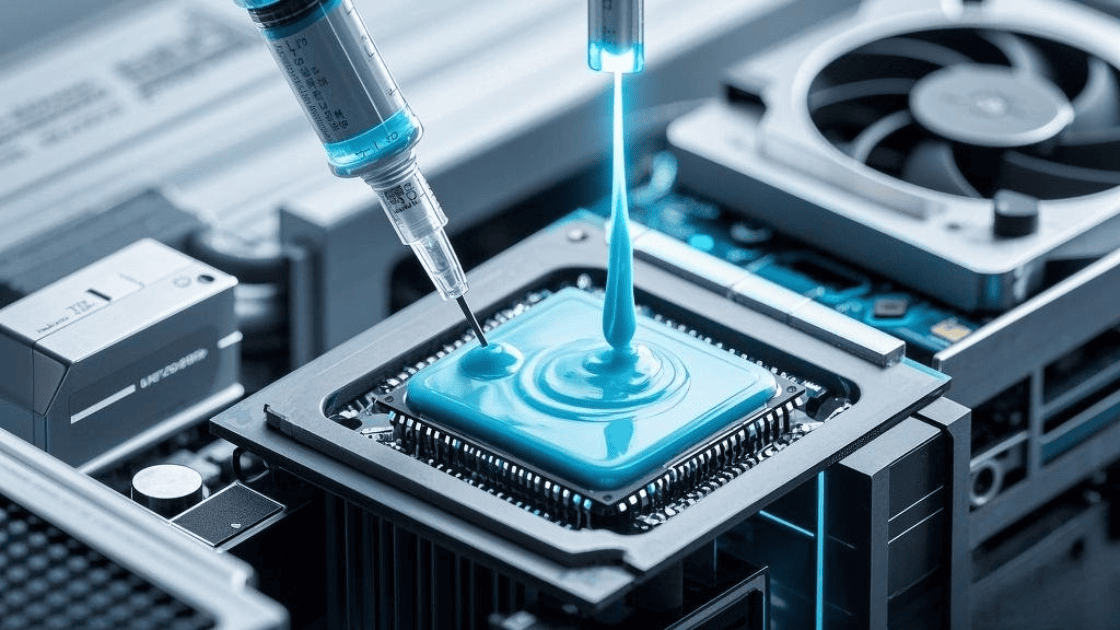
Manufacturers use thermal silicone compounds in paste form between the surfaces of the CPU and its coolers. These compounds not only fill the gaps but also create strong attachments. They improve heat dissipation, lowering the CPU temperature by 10-20°C. It makes systems work faster and last longer.
LED Lighting
As you know, LED lights are a steady, uninterrupted light source, so they generate excessive heat. Which is why silicone compounds in LED lights keep them cool. They improve the brightness of light and extend its lifespan up to 50,000 hours.
Power Electronics
Power electronics like inverters convert direct current to alternative current (AC) in many applications such as solar, motors, conditioners, etc. They get heated up during operations. Here, silicone compounds fix this issue by reducing the heat. They improve device efficiency by 5-10%, saving energy and reducing costs.
Application-Specific Requirements
Aerospace
Releasing gas in sensitive aerospace parts quickly damages them. Outgassing is the process where materials release trapped gases when they are exposed to some kind of vacuum environment. Silicone thermal compounds reduce this base rate to as low as 1% total mass loss (TML).
Automotive
Automotive applications must be made to contain vibration-free parts to perform smoothly. They need materials that can handle vibrations. For example, using silicone compounds, engineers can avoid vibrations up to 20 times the force of gravity. These materials provide durability.
Consumer Electronics
Consumer electronics need easy application and non-toxic material. For this, thermal silicone compounds offer better consistency. It gives a viscosity of 100,000-500,000 cP for smooth application and safe use.
Emerging Applications
5G Infrastructure:
5G devices are built with the latest technology. They generate a lot of heat. Silicone compound usage in these devices keeps them cool. These paste fill the tiny gaps and improve data speed up to 10 Gbps, providing better connection.
Electric Vehicles (EVs):
Manufacturers use thermal silicone compounds in electric vehicle batteries and motors. These solutions control battery temperature fluctuating between 20 to 40 °C. They also improve operating systems and range by up to 15%.
Advantages of Thermal Silicone Compounds

High-Temperature Stability:
Generally, thermal silicone compounds can operate under -50°C to 250°C temperatures. However, most of the materials depend on their usage and several considerations.
Manufacturers make certain grades of compounds like Shin-Etsu Silicone KE-552-U to handle higher temperatures up to 200 to 300°C. These are ideal for automotive gaskets and seals.
Chemical Resistance:
Thermal silicone compounds act as barriers that stop reaching oils, acids, and solvents inside the surfaces. For example, they can resist sulfuric acid at concentrations that exceed 30% without affecting its performance.
Weather Resistance:
UV exposures directly impact outdoor devices. At this point, special coatings and materials like silicone compounds become necessary. In particular, thermal compounds handle sunlight radiation. They maintain performance over 2,000 hours and humidity levels up to 95%.
High Transparency:
Specialized silicone compounds emit light in the visible range of frequencies over 90%. These work best for LED and optical devices where clarity is important.
Hydrophobicity:
Hydrophobicity is the ability to prevent water. Basically, contact angles are the ways to measure it. In silicone compounds, this contact can be around 110° or more. They are capable of repelling moisture to stop the occurrence of rust in electronic parts.
Electrical Isolation:
Thermal silicone compounds give a dielectric strength of 15-20 kV/mm. That is necessary for safe operations of high-voltage applications like power electronics.
Trade-offs
● Silicone compounds that have high thermal conductivity (up to 10 W/m·K) are not very flexible.
● They often have elongation rates as low as 50%.
● It can be hard for you to get high thermal conductivity and high flexibility in one silicone compound.
● Silicone compounds can manage high temperatures, but above 200°C can be difficult for them.
● Balancing thermal conductivity and dielectric traits in one silicone compound can be tricky.
Long-Term Reliability
Silicone compounds remain firm in long-term operations. They can endure over 1,000 repeated experiences of low to high temperatures (-40°C to 150°C).
Additionally, these thermal compounds do not break, crack, or lose adhesions easily. They can repel creep at pressures around 100 psi. Furthermore, silicone thermal compounds show minimal dry-out even after 10 years of use.
Comparison with Other Thermal Interface Materials
Specific Material Examples
| Materials | Thermal conductivity | Temperature stability | Usage | Applications |
|---|---|---|---|---|
| Thermal Silicone Compounds | High (1-10 W/m·K) | -50°C to 250°C | Flexible and easy to use | Perfect for electronics (CPU, PCB, heat sinks) |
| Acrylic-Based Tapes | Lower (0.5-2 W/m·K) | -20°F to 400°F | Easy to apply and no need for a longer curing time | Beneficial in low-power devices (attaching vehicle trim, gaskets) |
| Thermal Pads | Moderate (1-5 W/m·K) | -50-200°C | Help in filling large gaps | Specific parts of CPUs, GPUs, and power supplies |
Durability Comparison
Most of the silicone compounds, like RTV silicone, work best even under harsh weather (up to 300°C). They offer stability up to 177°C. These compounds also handle wet humidity better than epoxy or polyurethane.
However, this does not mean the other applications are not beneficial. They work according to the project’s needs. For example, epoxy stays in places strongly, and polyurethane provides better flexibility in low-temperature gadgets.
Performance Benchmarking
● Silicone compounds have low thermal resistance: basically around 0.1-0.5°C·cm²/W. That makes it efficient. Because lower resistance means better heat movements.
● Acrylic tapes offer 0.5-1.5°C·cm²/W thermal resistance.
● Thermal resistance in thermal pads is as low as 0.2-0.8°C·cm²/W.
Cost Considerations
The cost of each compound depends on the region and other factors, like the addition of fillers and their materials. Somehow, silicone compounds available are moderately priced, mostly around 10−50 per kilogram.
Meanwhile, acrylic tapes are cheaper (5−20 per kilogram). Thermal pads are much more expensive (20–100 per kilogram).
Selection Criteria for Thermal Silicone Compounds
Thermal Conductivity:
Thermal conductivity parameters correlate with the performance of how well the material transfers heat. For example, a silicone compound with 1-10 W/mK works perfectly for high-heat devices.
Viscosity:
Viscosity in thermal compounds refers to the thickness or thinner levels of liquid. This can impact its application. For example, a viscosity of 100,000 to 500,000 cP means it’s thick enough to stay firmly on surfaces and easy to spread.
Consistency:
The consistency of compounds shows stickiness. It tells how smoothly compounds flow in places. For instance, a smooth liquid fills gaps properly and ensures even heat transfer.
Data Sheets
Manufacturer data sheets help in measuring important details. For instance, density (3.1 g/cm³), porosity (0%), and maximum temperature limit (1650°C). This sheet also guides you in choosing the optimal material for your needs.
Testing and Validation
Thermal Cycling Stability: This test refers to experiences of fluctuating temperatures that a compound can manage. For example, it must maintain performance even after 1,000 cycles.
● Creep: This test helps in knowing whether the compound degrades or deforms under pressure. A good material option avoids creep, possibly under 100 psi of pressure.
● Dry-Out: This means the compound must not dry up over time and at least last up to 10 years.
Form Factor and Dispensing
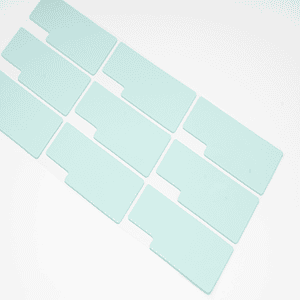
The form factor is the shape of the compound. It can be a paste, pad, or tape. Paste compounds are available in versatile options. Meantime, pads are easy to work with.
Dispensing refers to how easily a compound can be applied to detailed parts. Easy applications save time, spread easily, and require less effort.
Conclusion:
Thermal silicone compounds manage heat in electronic parts. They give better thermal conductivity, strength, and extended thermal cycles, along with stability under intense temperatures. Look for a compound based on viscosity, consistency, and form factor to get optimal outputs. In LED lighting, where excess heat can significantly impact lifespan and brightness, Jiuju offers thermal management solutions that incorporate high-performance silicone compounds. These solutions help manufacturers meet stringent performance requirements and extend product warranties.