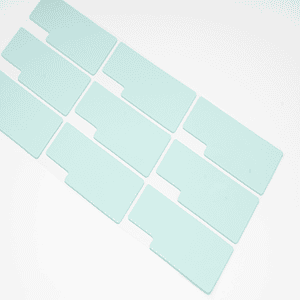


Thermal adhesives are important particles. Manufacturers use them to bond electronic or heat-sensitive assemblies. For instance, mobile phones, computers, or LEDs can be used. These adhesives offer good thermal conductivity and transfer heat away.
Thermal adhesives come in pastes, tape, and films. Consider your project’s thermal and mechanical attributes before choosing the right adhesive.
In this article, learn the top three applications of thermal adhesive in electronics.
II. What are Thermal Adhesives?
Thermal adhesives are kinds of bonds. They provide excellent thermal conductivity in electronic parts. Manufacturers use them to keep devices cool and for efficient heat transfer.
A. Types of Thermal Adhesives
Epoxy:
Epoxy adhesive is a strong bonding option for tough components. It lasts over 20 years. This adhesive needs heat above 120 °C for drying. Apply the same temperature to peel them out. This bond is strong and can handle harsh conditions. You can use them in concrete, wood, metals, some plastics, etc.
Silicone:
Manufacturers make silicone adhesive using silica. This bond is easier to bond two parts together than epoxy. It remains adaptable at temperatures up to 200 °C. These adhesives usually last around 10–15 years.
Acrylic:
Acrylic adhesives are less strong than epoxy. They dry quickly and last 5 to 7 years. Additionally, this glue barely handles temperatures above 120 °C. You can use this adhesive for quick fixes like patching small cracks.
Form of Thermal Adhesives
Paste:
Past adhesives are thicker and easily spread on uneven areas. You can use them manually or via a spatula for larger sections. However, it often drips over components and creates messiness. Paste adhesives offer thicknesses up to 0.1-0.5 mm.
Film:
Film adhesive is like a thin sheet and offers the simplest method. Control the tack of the film and use a roller or press for even bonding. You can use it by applying heat of 100-150 °C. The thickness of the film adhesive is around 0.05-0.5 mm.
Tape:
Tape has a low adhesion rating on a scale of 1–5. You can apply it manually. Peel out its backing and place it on the areas you want to bond. These adhesives are for temporary use because they are not very strong but can be used on lighter parts.
B. Thermal Conductivity Mechanisms
Fillers:
Fillers refer to tiny particles. They offer high thermal conductivity (e.g., 100 W/mK or higher). Manufacturers mix them into the adhesive to make pathways for heat transfer quickly.
Polymer Matrix:
The polymer matrix is a sort of glue. These matrices have lower thermal conductivity (e.g., 0.1–1 W/mK). They stay in place, holding filler particles and evenly distributing heat.
C. Filler Materials: The Secret Sauce of Thermal Adhesives
Aluminum Oxide (Al₂O₃):
The aluminum oxide fillers transfer heat efficiently. They are like heat-conductive pathways within the glue. These fillers offer decent thermal conductivity (around 30 W/mK). Plus, they are an affordable choice.
Silver:
Silver provides higher thermal conductivity. That is around 429 W/mK. This is why silver is much better than aluminum oxide. It transfers heat super fast but comes with a significant price tag.
Aluminum Nitride:
Aluminum nitride provides a balanced thermal conductivity of as much as 180 W/mK. This material is more cost-effective than silver.
Boron Nitride:
Boron nitride is the go-to choice for fillers regarding heat conduction. It improves thermal conductivity by around 300 W/mK. However, this material is costly. Manufacturers use it for high-tech devices where effective heat transfer is needed.
Other fillers:

Other possible fillers involve AgCuTi (a silver-copper-titanium alloy), copper foil or foam, and Kovar alloy. They spread heat away and give thermal conductivity up to 1 W/mK to over 10 W/mK. However, thermal conductivity varies based on the fillers.
D. Adhesion Mechanisms: How Thermal Adhesives Stick
Chemical Bonding:
Chemical bonding demonstrates the strong adhesion between the adhesive and the surface. These bonds stick firmly between multiple joints. They offer very good holding power ranging from several MPa to tens of MPa, often exceeding 10 MPa.
Van der Waals Forces:
The Van der Waals forces are tiny particles like magnets. They are weaker than chemical bonds but still offer good adhesion among parts. Additionally, their weaknesses range from a few kPa to tens of kPa, usually below 100 kPa.
Key Properties and Testing Methods
Thermal Conductivity:
Manufacturers use laser flash analysis (LFA) to calculate thermal diffusivity. They apply flash heat to the front face of a sample. A temperature detector helps them track the temperature rise on the rear face over time.

Just as the image shows the formula (α = 0.1388 * L² / t₁/₂.) for getting thermal diffusivity (a) measurement, use part thickness (L) and the duration it takes for the rear face temperature to drop half its maximum value (t₁/₂).
Bond Strength:
To test bonds between parts, manufacturers perform lap shear, peel, or tensile tests. For instance, strong thermal adhesives often rise from 15 MPa in lap shear tests.
Thermal Resistance/Impedance:
Low thermal resistance (< 0.2°C·cm²/W) in adhesions enables it to efficiently move away the excessive heat.
Operating Temperature Range:
The operating temperature of adhesion fluctuates between −60°C and 250°C. This temperature also depends on formulation and offering durability in critical conditions.
Viscosity/Thixotropy:
Thermal adhesives that have high viscosity (e.g., > 100,000 cP) are thick in form. On the other hand, thixotropic types are thin, aiding usability.
Cure Time/Temperature:
Each adhesion curing time varies. Some of them dry quickly, even at room temperature. Other types need proper heating (e.g., 120°C for 30 minutes) or UV light.
Application 1: Heat Sink Attachment
Thermal adhesion makes proper and strong attachments to heat sinks. They effectively transfer heat through their electronic components. The manufacturer carefully fills the micro-gaps to improve thermal conductivity. Adhesive can dissipate heat up to 100 w in bonded fin heat sinks.

This image shows the thermal adhesive is applied to heat sinks on PCBs. For example, conductive grease, paste, and plaster are often called “thermal mud.
Figures:
● Extruded Heat Sinks: they are high strength and offer thermal resistance of 0.5–1.5°C/W.
● Stamped Heat Sinks: They are lighter and affordable. It provides thermal resistance 1.0–3.0 °C/W.
● Bonded Fin Heat Sinks: The thermal conductivity of this heat sink is around 5–15 W/mK. They are useful for systems dissipating over 50 W.
Bond Line Thickness
The bond line is the adhesive layer. It stays between the heat sink and the component. Its thickness causes changes in thermal performance. For instance, a 0.1–0.3 mm bond line works well for most parts. However, maintaining thicker layers can increase the resistance level of thermal over 1.0 °C/W. Conversely, thinner layers make poor connections and create air gaps.
Surface Preparation
Proper surface cleaning lets the adhesive stick strongly. You can use 99% isopropyl alcohol or acetone. That helps in removing contaminants, oil, and dust. Additionally, provide enough time to dry the surfaces before applying adhesive.
Dispensing Methods
Manufacturers use syringes or automated systems for small areas to larger areas. These methods help them get precise results. They can achieve application rates of up to 50 mm/s.
Specific Examples
Thermal adhesives help spread away excessive heat in CPUs, GPUs, and power transistors. They can control these loads up to 150 W.
Additionally, manufacturers use thermal simulation tools. These tools help them in making efficient models targeting thermal conductivity values of 1–10 W/mK.
Application 2: Component Mounting
A. Surface Mount Technology (SMT)
Thermal adhesives are very important to SMT. They attach or mount components on boards strongly. That dissipates high power. Additionally, these adhesives maintain stability and thermal efficiency.
The image shows several components of PCBc that are attached using thermal adhesive. For instance, underfill edge bonding, conformal coating, thermally conductive adhesive, SMD die attach, and electrically conductive adhesive, etc.
B. Underfill
Thermal adhesives are important underfill particles. They improve the reliability and thermal performance of flip-chip packages and BGAs. Also, it offers long-term durability.
C. Die Attach
You can also use thermally conductive adhesives when attaching dies to integrated circuits. They give high-performance paths to travel heat from all mounted components.
D. Specific Examples
Manufacturers use thermal adhesives to mount various components. For instance, LEDs and power diodes. Adhesives in parts control heat loads of up to 200 W. Manufacturers also pass these items through several reliability tests. That includes thermal cycling and humidity (up to 85% RH) testing to validate performance.
Application 3: Thermal Interface Materials (TIMs)
Thermal Interface Materials (TIMs) take heat away between component surfaces. Manufacturers use them to fill the gaps. They can manage temperatures from -40°C to 150°C, and thicknesses range from 0.1–1 mm.

The given image highlights the importance of TIMs in improving CPU cooling. It shows no TIMs microscopic air gaps between the heatsink and processor hinder heat transfer. Proper filling gaps with TIMs improves the motherboard’s thermally conductive materials.
A. Types of TIMs
There are three common types of TIMs: thermal greases, thermal pads, and thermal adhesives.
● Thermal greases work well on high-performance CPUs
● Thermal pads provide ease of use for standard to ordinary setups
● Adhesives are perfect bonds to make secure, long-lasting applications.
B. Thermal Resistance of Interfaces
Typically, interfacial thermal resistance varies between 0.1–1.0 °C/W. It impedes heat transfer. Thermal adhesives lower down these resistances. They create very strong and seamless attachments between components.
C. Phase Change Materials (PCMs)
Phase-change materials in thermal adhesives transfer heat better. They change state at specific temperatures (50–70 °C). Additionally, these materials optimize performance during high thermal loads.
D. Specific Examples
Manufacturers use thermal adhesive TIMs between heat spreaders and heat sinks. They create thermal conductivities of 1–10 W/mK.
In contrast with other TIMs, they strongly stick to parts and allow easy applications for specific designs. Additionally, they provide reliability in demanding environments.
Conclusion:
Thermal adhesives transfer heat away from heat sinks and other devices. They secure component mounting and keep them cool. Additionally, manufacturers use them in parts to improve their thermal interface materials.
Jiuju offers a wide range of high-strength adhesives for diverse applications. From quick-drying glue (25MP) to specialized epoxy, anaerobic, acrylic, thermally conductive silicone, and UV adhesives, our company gives you the best bonding solution for your project. Contact us for a free quote online!