Data Center & AI Clusters
High-density switch faceplates pack hundreds of 800G modules side by side. Our low-thermal-resistance TIMs pull heat into riding heatsinks without stressing delicate optical components.

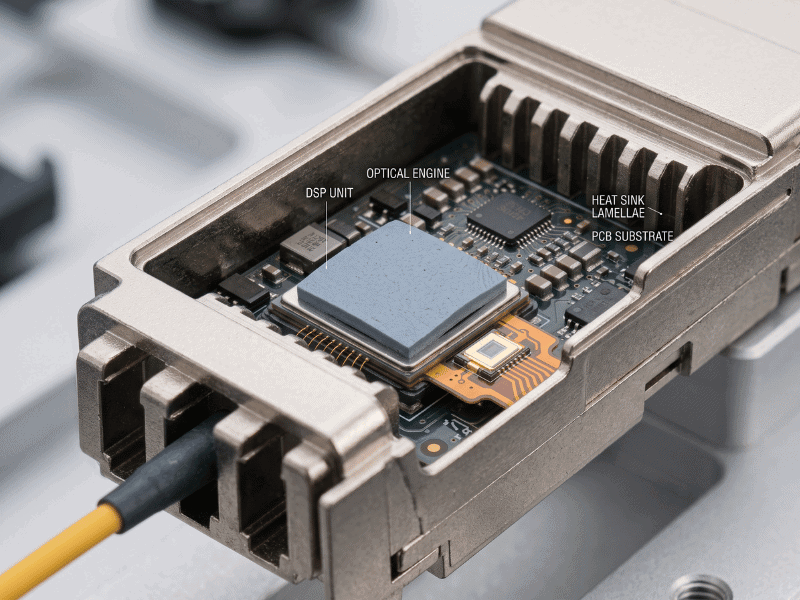
As data rates climb from 400G to 800G and beyond, power density inside QSFP-DD and OSFP form factors rises sharply. DSP chips, laser drivers and TOSA/ROSA assemblies now dissipate 12–20 W in a tiny, sealed enclosure—while the optics themselves are highly temperature-sensitive. Even small thermal gradients cause wavelength drift, higher bit-error rates, and shortened laser lifespan. Efficiently moving heat from the module case to the cage, riding heatsink or cold plate is now mission-critical for data center and AI cluster reliability.
High-density switch faceplates pack hundreds of 800G modules side by side. Our low-thermal-resistance TIMs pull heat into riding heatsinks without stressing delicate optical components.
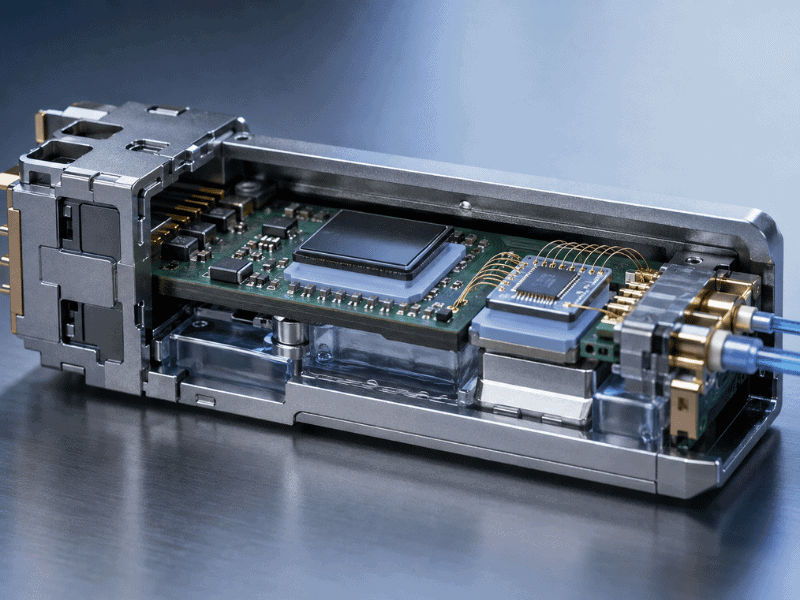
Target the hottest spots—DSP, driver ICs and laser diodes—with soft, conformable pads that maximize contact and stabilize operating temperature for consistent optical performance.
| Property | Value |
|---|---|
| Thermal Conductivity | 1.5 – 8.0 W/m·K |
| Dielectric Breakdown Voltage | > 6.0 – 10.0 kV/mm |
| Hardness & Deflection | 0.5–5 mm |
| Shore 00 20 – 50 (High Compressibility) | -50°C to +200°C | UL 94 V-0 |
| Ideal EV Applications | OBC, DC-DC, High-Voltage PDU, Battery Packs |
| Property | Value |
|---|---|
| Thermal Conductivity | 2.0 – 6.5 W/m·K |
| Dispensing Flow Rate | High Thixotropic / >40 g/min |
| Outgassing (Siloxane) | Ultra-low Outgassing / Non-Silicone Available |
| Operating Temp & Reliability | -50°C to +180°C | Anti-Slumping |
| Ideal EV Applications | ADAS Cameras, LiDAR, ECUs, Sensor Modules |
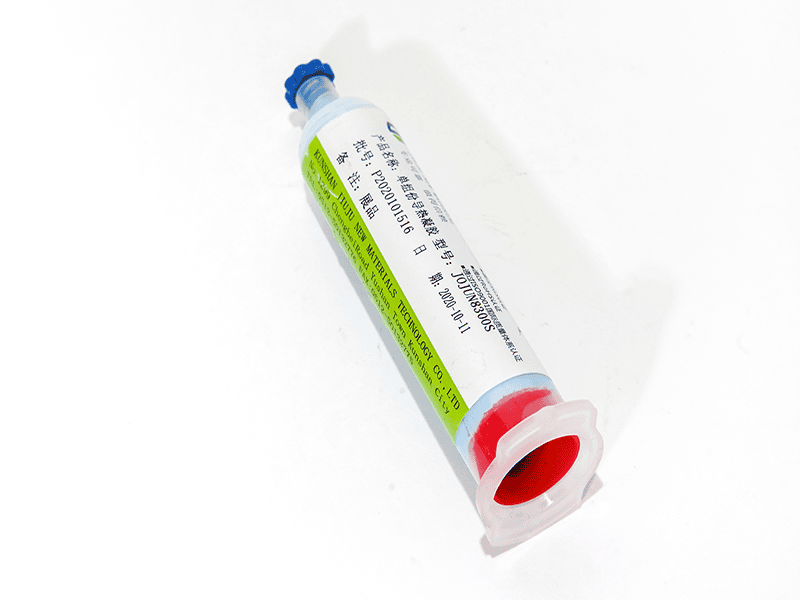
| Property | Value |
|---|---|
| Thermal Conductivity | 3.0 – 6.5 W/m·K |
| Thermal Impedance & BLT | < 0.04 °C·in²/W | Min BLT ~15 µm |
| Dielectric Breakdown Voltage | > 4.0 – 8.0 kV/mm |
| Operating Temp & Reliability | -50°C to +180°C | Anti-Pump-Out (>1,000 hrs) |
| Ideal EV Applications | SiC/IGBT Power Inverters, MCU Chipsets, Fast Chargers |
Trusted by Industry Leaders for Reliable Performance and Exceptional Quality



Extend Battery Cycle Life by up to 25 %: Better heat removal means less stress on cells. Reduce System Weight & Complexity: Thin pads replace bulky cooling assemblies. Lower Maintenance Costs: Stable thermal performance minimizes downtime.


It depends on your gap size and assembly process. Ultra-soft thermal pads suit uniform gaps and protect fragile optics with low mounting force; thermal grease gives the thinnest bond line for high-volume automated lines; gap fillers handle uneven geometries and larger tolerances (e.g. OSFP cases to cold plates). We’re happy to recommend the right option for your design.
By filling air gaps between the module case and heatsink, a low-thermal-resistance interface typically lowers case and laser temperatures by several degrees. This directly improves wavelength stability, reduces bit-error rates, and extends laser diode lifespan.
No. Our ultra-soft, highly compressible formulations conform to the surface at minimal mounting pressure, so they relieve rather than add mechanical stress. Low-outgassing polymers also protect sensitive optical components over the module’s full service life.
Yes. Our dispensable grease and form-in-place gap fillers are optimized for automated, high-throughput assembly, delivering thin, uniform bond lines unit after unit—ideal for data center and telecom manufacturing at scale.