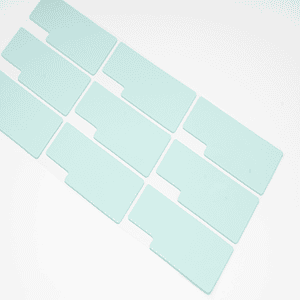

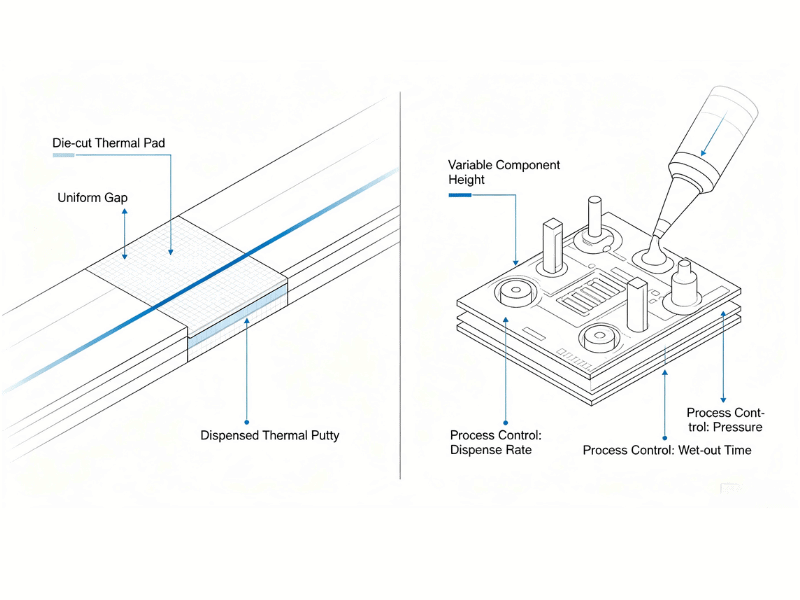
Choose a thermal pad when the gap is measurable, the part geometry is repeatable, and you want a preformed, inspectable interface. Choose thermal putty or dispensable gap filler when the gap is highly irregular, component heights vary widely, or one sheet thickness would create excessive force.
The trade is control. Pads require tight geometry and thickness selection. Putty requires controlled dispensing, bond-line thickness, material flow, and long-term stability.
Quick comparison
| Criterion | Thermal pad | Thermal putty / dispensable gap filler |
|---|---|---|
| Incoming geometry | Fixed sheet thickness and die-cut | Bulk container or cartridge |
| Gap variation | Best for defined range | Better for wide, irregular variation |
| Assembly force | Depends on hardness and compression | Often lower initially, formulation-dependent |
| Process control | Placement, liner removal, compression | Dispense volume, path, speed, and closure |
| Rework | Usually clean and discrete | Can be messier and harder to restore exactly |
| Automation | Pick-and-place or manual placement | Metered dispensing |
| Main risk | Missed contact or excessive pad force | Voids, slump, pump-out, or volume variation |
| Inspection | Thickness, dimensions, placement | Weight/volume, bead geometry, final BLT |
When a thermal pad is the better choice
Use a pad when you need:
- A defined, measurable nominal thickness
- Clean handling and straightforward rework
- A die-cut shape with controlled keep-out zones
- Electrical insulation from a specified sheet construction
- Easy incoming dimensional inspection
- Stable placement before lid closure
Pads work best when the minimum and maximum assembly gaps fit inside the exact grade’s approved compression window. Use the thermal pad thickness selection guide to calculate that range.
When thermal putty is the better choice
Use putty or a dispensable gap filler when:
- Component heights vary too much for one pad
- The interface contains complex contours
- The gap changes across a large area
- A thick sheet pad would create excessive force
- Automated dispensing can control volume more efficiently than many die-cuts
- Late-stage design changes make fixed pad tooling inconvenient
Putty is not a “no measurement required” material. You still need target bond-line thickness, dispense volume, coverage, closing force, and overflow limits.
Do not confuse putty with a phase-change material
Thermal putty or dispensable gap filler is designed to occupy a comparatively large or irregular gap. A phase-change material is normally used as a thin interface between surfaces that already approach one another. It softens or flows at its designed transition temperature to wet the surfaces and reduce contact resistance.
Both may arrive as a paste-like or preformed product, but their design jobs differ:
- Gap filler or putty: Accommodates height variation; control dispense volume, final bond line, slump, pump-out and overflow.
- Phase-change material: Forms a thin interface; control coating or preform thickness, activation conditions, assembly pressure, coverage and rework.
- Thermal pad: Bridges a defined gap as a compressible solid; control free thickness, tolerance, hardness and compression force.
Do not substitute one category because its conductivity number looks similar. First decide whether the joint needs gap filling, surface wetting, or both. Then validate the material form and process in the installed geometry.
Thermal performance: compare the installed interface
For a pad, thickness and contact pressure are central. For putty, final bond-line thickness, voids, and material displacement are central.
ASTM D5470 covers thermal impedance measurement for materials ranging from viscous liquids to viscoelastic solids. The standard’s categories help explain why a preformed pad and a flowable gap filler should not be compared using conductivity alone.
Request data at conditions close to the design:
- Final thickness or bond line
- Pressure
- Temperature
- Aging or cycling state
- Substrate finish
- Whether resistance includes interfaces
Mechanical design differences
Pads store elastic energy
A compressed pad pushes back. Its force can bow a PCB, tilt a cooler, or load the tallest component. ASTM D575 provides a standard context for compression-deflection behavior.
Putty moves
A putty can flow away from high spots into open volume. That helps accommodate tolerances, but it makes dams, keep-outs, overflow, and long-term pump-out important.
Large areas amplify the issue
For both materials, total force and displaced volume scale with area. A solution that works on a small controller may not scale directly to a battery module or cold plate.
Manufacturing and quality controls
Thermal pad control plan
- Grade and lot
- Thickness and tolerance
- Shore 00 hardness
- Die-cut dimensions
- Adhesive/liner construction
- Placement and orientation
- Contact print and final compression
Jiuju reports that thermal-pad shipment reports can include conductivity, hardness, dimensions, appearance, and agreed customer tests.
Putty or gel control plan
- Mix ratio for two-component systems
- Viscosity or extrusion rate
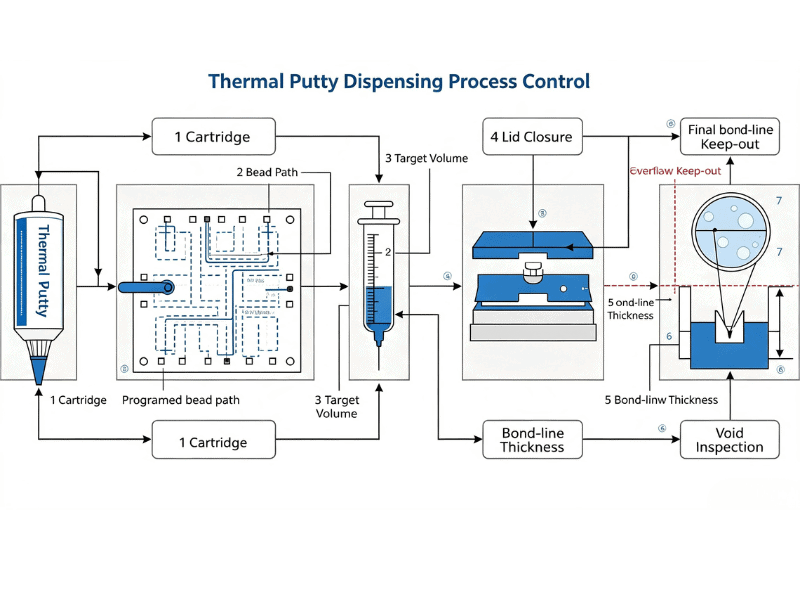
- Dispense weight/volume
- Bead position and continuity
- Final bond-line thickness
- Cure or pre-cure condition, where applicable
- Slump, pump-out, and cycling performance
Jiuju reports that two-component thermal-gel shipment checks can include conductivity, viscosity, cured hardness, packaging, and customer-defined items. For single-component pre-cured gel, reported checks include conductivity, extrusion output, appearance, and packaging. Confirm the exact product category: not every “gel” cures in the assembly.
Release the material and dispensing process together
Jiuju documents using APQP and DFMEA/PFMEA in product development. For a dispensable interface, turn the identified risks into measurable controls: cartridge identification, storage and conditioning, mixing where applicable, dispense weight or volume, bead continuity, open time, closure displacement, overflow keep-out and rework method.
The reaction plan matters as much as the nominal setting. Define what happens after a missed bead, air interruption, expired working time or unplanned line stop. Record lot, equipment recipe and dispense result so a thermal or contamination failure can be traced. Jiuju’s documented issue flow progresses from technical inquiry through evaluation and solution to an 8D-style corrective-action loop; production data makes that loop useful.
For pads, the parallel controls are grade, thickness, Shore 00, die-cut geometry, liner removal, placement and compression. Material form changes the control plan, not the need for one.
Contamination, bleed, and environment
Sensitive optics, sensors, relays, and sealed housings may need low-bleed or non-silicone products. Compare:
- Volatile content and test method
- Oil-bleed method and acceptance limit
- Pump-out after thermal cycling
- Compatibility with plastics, coatings, and adhesives
- Operating temperature and humidity
- Rework solvents and cleanliness
Jiuju reports non-silicone F6000 pad grades and low-bleed LB pad grades. Ask for the applicable test report rather than transferring a family claim to a different material form.
Its supplied product data reports volatile mass loss of no more than 0.5% after 120°C for 72 hours for the specified non-silicone F6000 pad family. Keep the test condition and material family attached to the value; it should not be generalized to putties, gels or other pad grades. Jiuju’s reliability menu also includes oil-bleed and environmental evaluations, with conditions and acceptance limits set for the selected project.
Decision workflow
Before shortlisting either material, answer five questions:
- Geometry: Is the gap uniform, repeatable, and measurable, or irregular and multi-height?
- Thermal duty: What are the total heat load, local hotspot distribution, contact area, and allowed temperature rise?
- Mechanical and electrical limits: How much pressure can the components accept, and what insulation must remain after assembly?
- Process: Will production place a die-cut sheet or meter a controlled bead more repeatably, including inspection and rework?
- Reliability: Which risks dominate—loss of contact, movement, bleed, volatility, cycling, vibration, or contamination?
Avoid turning any one answer into a universal power, area, or material cutoff. The five answers define the test conditions and narrow the material form; installed performance decides the release.
- Map the gap range and topography.
- Define heat load, electrical, and environmental requirements.
- Calculate pad compression and force for candidate sheets.
- Estimate putty volume and final bond-line range for a dispensable option.
- Compare process capability, automation, and rework.
- Prototype both if the decision is close.
- Run controlled thermal, mechanical, and reliability tests.
- Release the material and process specification together.
FAQ
Is thermal putty better than a thermal pad?
It is better for some irregular gaps, but it requires tighter process control of volume and final thickness. Pads are often cleaner and easier to inspect.
Can thermal putty replace stacked pads?
Often, yes, especially when stacking is compensating for uneven heights. Validate pump-out, voiding, overflow, and rework before production use.
Does thermal putty apply less pressure?
Many formulations conform at low initial load, but behavior varies. Check the exact material, closure speed, volume, and aging response.
Which option is easier to automate?
Both can be automated. Pads need reliable picking, liner removal, placement, and compression. Putty needs calibrated dispensing, bead inspection, and final bond-line control.
Choose the process with the material
The thermal pad versus thermal putty decision is not only about W/m·K. It is a choice between two manufacturing systems.
For predictable gaps, start with Jiuju’s thermal pad products. For complex or uneven gaps, review its thermal gel products. In both cases, release the geometry, material grade, process controls, and validation criteria as one package.