
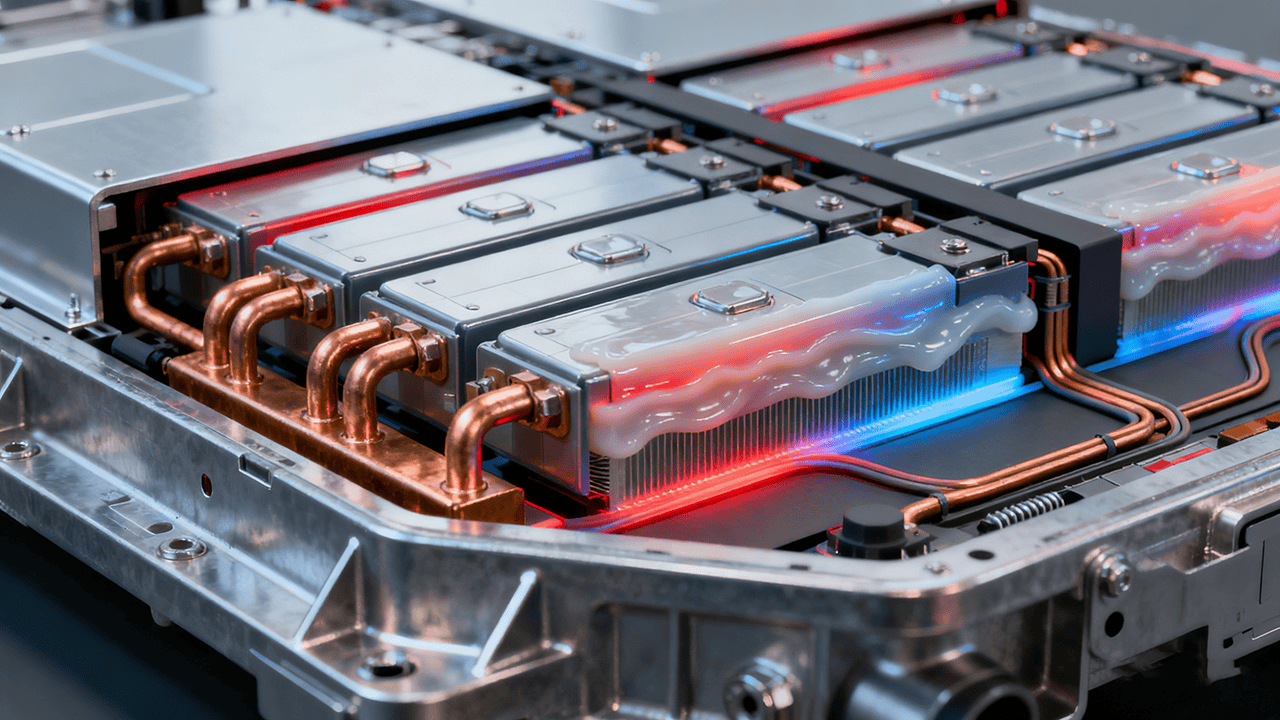

The move towards electric vehicles keeps accelerating, and engineers are packing today’s EV batteries with far more electrical energy than earlier generations ever carried. More power is great for range, but it also brings a familiar headache: more heat. A heavily loaded battery pack, especially during fast charging, can warm up quickly. Inside every li ion battery and every cluster of li ion cells, that heat pushes lithium ion batteries toward temperatures that squeeze safety margins and stress the chemistry. Cross the battery’s maximum temperature limit, and the odds of thermal runaway rise fast.
That’s why a solid battery thermal management strategy isn’t just a design choice anymore. It’s the backbone of modern pack engineering. And sitting right at the center of any thermal conductivity electric vehicle battery pack design is one property that quietly decides everything: thermal conductivity. How well a material moves heat determines whether the system stays efficient, safe, and within its optimal temperature window, even when active cooling systems are working hard.
In this guide, we break down the fundamentals, key material-selection criteria, real benefits of high-conductivity TIMs, and practical insights for B2B suppliers aiming to raise the standard of future battery technologies.
What Is Thermal Conductivity and Why It Matters in Battery Packs
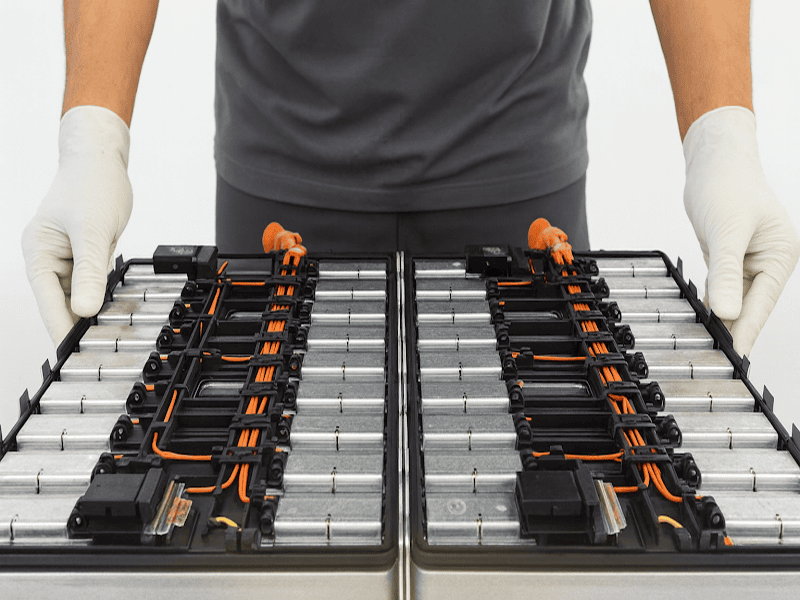
Thermal conductivity, written as k, describes how easily a material moves heat. It is measured in W/(m·K). Even modest increases in k can influence how an EV battery pack behaves during heavy use, because higher conductivity allows heat to travel more quickly through the material.
Inside lithium ion batteries, most heat moves through conduction. When the thermal path is thin and consistent, heat leaves the cell efficiently. When the path is thicker or uneven, Fourier’s Law highlights the effect: more resistance, slower heat flow, and rising battery temperature.
A few practical situations make this easy to see:
- Fast charging produces significant heat inside li ion battery cells.
- Thick TIM layers slow heat dissipation and trap warm spots.
- Uneven contact surfaces encourage hot spot formation.
- Higher temperatures increase the likelihood of thermal runaway.
Most cells perform best between roughly 15 and 35 degrees Celsius. A peer-reviewed Energies study titled “Temperature, Ageing and Thermal Management of Lithium-Ion Batteries” confirms that operating outside this optimal range increases degradation and mechanical stress
This is why EV engineers depend on high quality thermal interface material. Gap fillers, TIM pads, and thermally conductive adhesives help pull heat away from battery surfaces and support safer, more stable battery thermal management across the system.
Key TIM Selection Factors for EV Battery Packs
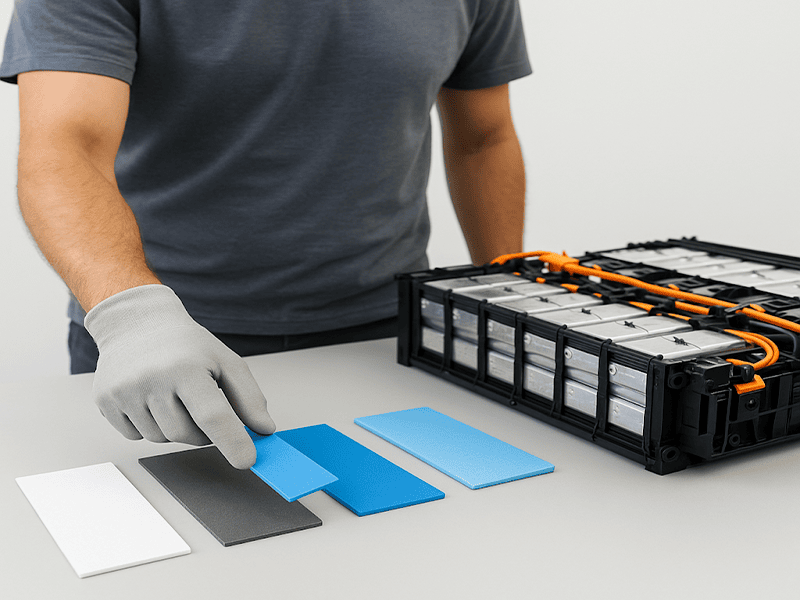
Picking a thermal interface material might look simple at first, but have you ever seen how much it influences the way an EV battery pack handles heat? The right TIM keeps temperatures in check, helps the pack stay steady under load, and makes the whole system run more smoothly. Each part of the TIM’s design plays a role in how well that happens.
Thermal Conductivity Value
Thermal conductivity is one of the quickest ways to judge performance. A shift from about 0.2 W/(m·K) to roughly 2.2 W/(m·K) is a major upgrade. It lowers thermal resistance by more than a factor of ten, which helps the pack stay cooler during fast charging or when ambient temperature is high. That extra efficiency can prevent heat from building up inside the cells.
Thickness and Contact Area
A thinner TIM layer gives heat a shorter path to travel. A broader contact area lets it spread more freely. When these two elements work well together, the battery module avoids sharp temperature differences and the hot spots that tend to form under heavy load.
Other Properties to Consider
- Structural strength for cell-to-pack and cell-to-chassis layouts
- Electrical isolation for safety
- Pumpability and flow behavior during application
- Density and weight for better efficiency
- Fire-resistant traits for improved thermal runaway protection
Benefits of High-Conductivity TIMs
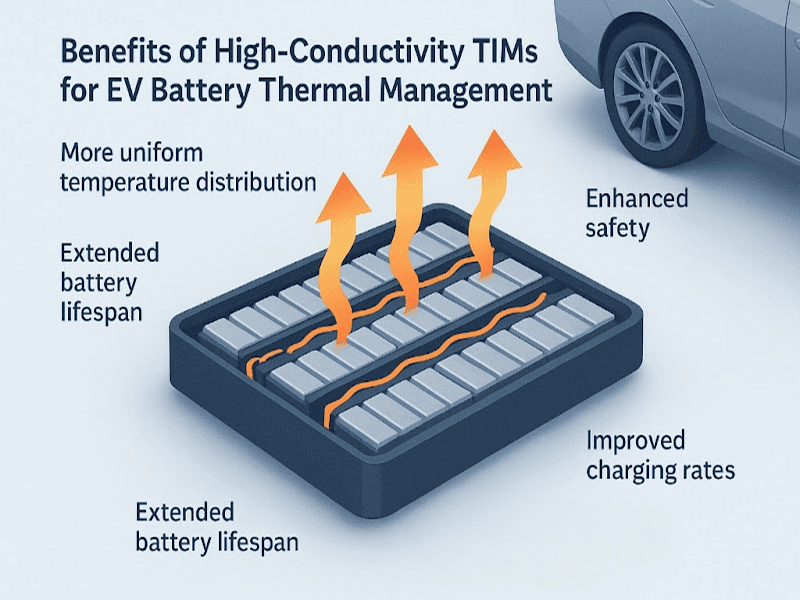
High-conductivity thermal interface materials can change the way an EV battery pack behaves under load. When heat leaves the cells quickly, everything feels steadier. Temperatures rise more slowly, performance stays more predictable, and the system does not fight against heat every time the driver asks for more power.
More Uniform Temperature Distribution
If you have ever looked at a pack during fast charging, you know how quickly hot spots appear. A high-k TIM helps smooth that out by spreading heat across a wider area. The temperature distribution across battery cells becomes more balanced, which means fewer sudden spikes and calmer behavior during heavy acceleration.
Extended Battery Lifespan
Cooler cells age at a slower pace. Lower temperatures reduce stress inside lithium ion batteries and help preserve capacity. Good heat dissipation also makes the battery pack work less aggressively to stay within its preferred range. Over time, that usually adds up to a longer-lasting system.
Enhanced Safety
What happens when heat is removed before it builds up? The pack stays safer. Effective heat transfer keeps temperatures from creeping toward the point where thermal runaway becomes a risk. A reliable TIM helps keep everything in a stable zone so the system feels less fragile under pressure.
Improved Charging Rates and System Efficiency
Have you noticed how charging slows down when a pack gets warm? When cells stay cool, they hold steadier cell voltage and accept charge more easily. Some pack designs even add a heat pipe or small phase change materials to keep temperatures closer to target levels. Strong battery thermal management reduces wasted energy and supports better charging performance overall.
Application Considerations for B2B Thermal Management System Suppliers
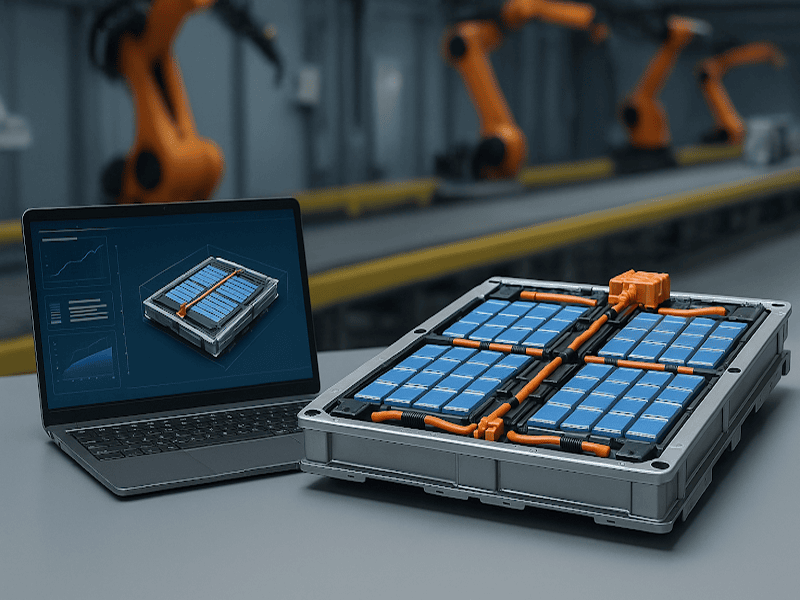
Choosing the right thermal interface material is only the starting point. B2B suppliers also need to think about manufacturing, system integration, and the long-term behavior of an EV battery pack.
How to Evaluate a TIM
When you look at a datasheet, what do you check first? Thermal conductivity is important, but it is not the only clue. Thickness, curing time, bonding strength, and flow behavior all reveal how well the material will transfer heat and keep battery temperature under control. It also helps to watch how internal resistance changes with temperature. A good TIM supports stable heat dissipation and keeps the battery thermal management system from fighting sudden spikes.
Manufacturing and Assembly Lines in a Modern Cooling System
Production compatibility matters. Gap fillers need the right viscosity for smooth pumpability, and adhesives must bond fast without slowing the line. A good TIM should fit cell-to-module and battery module assembly and work with both air cooling and liquid cooling inside the full battery cooling system.
The right materials help absorb heat, support stable cell temperature, and limit the heat generation rate during operation. This reduces sudden cell temperature rises and protects long-term battery capacity. TIMs with strong heat capacity also improve system stability during fast charging and heavy load.
Design Trends Increasing TIM Demand
If you’ve ever looked at a modern EV pack teardown, you’ve probably noticed how little free space remains. That shift alone is driving a big jump in TIM requirements.
Cell-to-pack layouts
Tighter spacing raises heat generation and makes the TIM layer more important than it used to be.
Cell-to-chassis integration
Structural bonding and thermal management start working together instead of as separate steps.
Higher energy density
More stored energy inevitably means more heat to deal with during load peaks.
Thinner gaps
As tolerances shrink, conductivity has to rise to prevent localized heating.
Emerging Challenges In Battery Thermal Management Systems
Some of the pressures facing TIM designers aren’t theoretical anymore. Anyone who works with pack testing has seen these come up:
- Higher-current fast charging puts a lot more stress on the thermal path.
- New compact cell formats run hotter and leave little margin for error.
- TIM layers are getting thinner, which makes uniform application harder.
- Cost and cooling efficiency need to balance realistically, not just on paper.
- Active and passive cooling methods need TIMs that behave predictably in both.
- Future pack architectures may require new bonding or flow characteristics altogether.
Jiujutech Case Study Snapshot
At Jiujutech, our next-generation thermal interface materials delivered real gains for EV battery packs. We reduced pack weight while raising thermal stability. Our low-density, high-conductivity TIMs managed heat flow even under intense stress.
Our latest gap fillers hit up to 3.2 W/m·K and adhesives up to 2.8 W/m·K, plus built-in latent heat buffering to damp sudden cell temperature rises. These materials integrated seamlessly into air cooled BTMS layouts and rigorous high-load cycles, improving thermal reliability without added complexity.
For materials formulators and B2B suppliers, the takeaway is clear: deliver lower weight, higher conductivity, structural bonding, and manufacturing-friendly TIMs. This aligns with modern battery thermal management system demands.
The Future of Thermal Interface Materials and What Suppliers Should Watch

If you follow the battery space closely, you can already see the direction things are headed. The demands on TIMs keep climbing, and a few themes are becoming hard to miss:
• Material Innovation
Expect TIMs with higher thermal conductivity, thinner layers, and multifunctional performance. These help stabilize battery temperature, reduce temperature variations, and support the needs of modern lithium ion batteries operating under high loads and rising ambient temperature conditions.
• EV Trends Increasing Thermal Stress
Bigger packs and higher high energy density mean more heat. Faster charging pushes battery thermal management systems harder. Both air cooling systems and liquid cooling system designs must work alongside TIMs to control extreme temperatures inside EV batteries.
• Safety and Regulation
Stricter rules on thermal runaway will make TIMs a core safety layer. They must integrate cleanly with the vehicle’s battery management system and support consistent thermal management system performance.
• Sustainability & Circular Design
EV platforms demand TIMs that allow easier disassembly, recycling, and second-life use of electric vehicle batteries. Lower-density materials also help reduce lifetime energy consumption.
• Digital and Manufacturing Integration
Advanced simulation tools will predict thermal pathways, optimize cooling system geometry, and validate TIM behavior during active cooling methods. This leads to better thermal performance and more efficient battery thermal management across future EV architectures.
Partner with Jiujutech for High-Performing EV Battery Packs
Thermal conductivity is not a “nice-to-have.” In every modern EV battery pack, it’s a critical performance pillar. For lithium-ion cells and high-density lithium ion batteries, proper heat flow underpins long life, safe operation and smooth battery thermal management.
At Jiujutech we specialize in advanced adhesives and thermally conductive materials designed for demanding battery systems. We deliver thermal interface materials (TIMs) with high k-values, fast manufacturability, and integration into complete thermal management system architectures for electric vehicles.
Ask yourself:
Are your k-values competitive?
Have your interface layers been optimized for thin gaps and high heat flux?
Is your substring of materials ready for modern cooling system designs, whether air or liquid cooling?
If you’re ready to raise your battery pack standard, we’re ready to partner. Request a white-paper download, schedule a pilot evaluation, or talk to our technical specialists. Let’s build safer, higher-performance packs together.
FAQs
Do EV batteries overheat while driving?
They can under heavy load, but active cooling systems and thermal management prevent dangerous temperature rises and maintain safe operation.
How can you prevent thermal runaway in batteries?
Keep temperatures stable. Avoid overcharging, use proper cooling, ensure good heat transfer, and choose high-quality cells with built-in protection features.
What type of TIM is best for high-energy-density EV batteries?
A high-conductivity TIM that maintains thin, uniform contact and handles high heat flux. Gap fillers and structural adhesives with strong thermal paths work best in dense EV pack designs.