
The GPU Heat Bottleneck
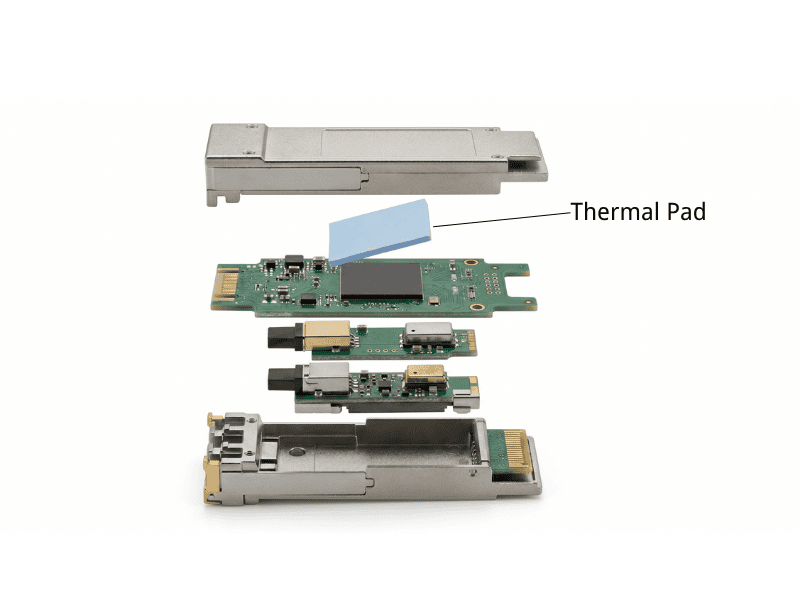
Here is the hard truth about modern AI infrastructure: your compute capability is entirely limited by your cooling capability.
We are packing 700W GPUs into tighter chassis than ever before. At this scale, heat dissipation is no longer a footnote on a datasheet—it’s the core challenge dictating system reliability. You can’t out-compute bad thermal management. If the heat gets trapped, everything else grinds to a halt.
Four Critical Thermal Challenges in AI Data Centers
If you’re designing or operating an AI data center, you already know that keeping your GPUs cool is no longer a simple engineering task.
The old cooling playbook we used five years ago simply doesn’t work for AI. The heat loads are just too massive.
Before we get to the solution, let’s look at the four biggest thermal headaches you’re probably fighting right now—and why solving them requires a Thermal Interface Material (TIM) actually built for the job.
Let’s dive in.
Extreme Heat Flux Density: When Standard TIMs Simply Can’t Keep Up
GPU die sizes are shrinking. But power output is surging in the opposite direction.
The result is an extreme heat flux problem: you’re packing way too much power into a tiny footprint. Standard thermal materials just choke under that kind of density.
Here is what that looks like on the test bench: a standard thermal pad does just fine on a consumer gaming rig. But slap that same material onto an AI accelerator pushing hundreds of watts through a die the size of your thumbnail? It’s going to bake. Thermal resistance shoots up, junction temps spike, and the chip throttles to save itself.
In high-density GPU arrays — where dozens of accelerators are packed into a single rack — this problem compounds quickly.
Standard pads just don’t cut it here. High heat flux demands a Phase Change Material (PCM) that actively melts into microscopic gaps, holding thermal resistance ultra-low under real-world loads.
Dynamic Load Cycles and Thermal Fatigue: The Silent Killer of TIM Performance
AI workloads are anything but steady.
AI workloads are brutal. Whether you’re training an LLM or running inference, your GPU is constantly slamming between full throttle and idle. Every single power spike triggers a massive temperature swing. This constant expansion and contraction acts like a mechanical hammer right on your thermal interface.
Over time, this relentless flexing triggers the ultimate TIM killer: pump-out. The constant expanding and contracting literally squeezes the thermal material right out from the center of the die, leaving behind dry, uncooled hot spots.
Here’s why that matters:
- Material migration creates voids and dry spots at the interface
- Interface degradation causes thermal resistance to climb steadily
- Hot spots emerge where heat can no longer escape efficiently
- Performance throttling kicks in as the chip’s thermal protection systems activate
- Premature failure becomes increasingly likely as junction temperatures approach critical limits
Surviving day one on the test bench is easy. The real challenge is locking in that exact same thermal resistance after thousands of brutal cycles in a production rack.
Near-100% Uptime Requirements: Zero Tolerance for Thermal Failure
Data centers don’t get to take breaks.
Hyperscale AI infrastructure is expected to operate continuously, around the clock, every day of the year. Any unplanned downtime — whether caused by hardware failure, thermal throttling, or a system shutdown triggered by overtemperature conditions — carries serious consequences.
What often goes unnoticed is how frequently TIM degradation sits at the root of these events.
When a thermal interface material loses performance over time — through pump-out, aging, or material hardening — the degradation is gradual and often invisible until it crosses a critical threshold. By the time an operator notices a problem, the damage to uptime, workload continuity, and downstream SLAs may already be done.
The hidden cost of TIM-related downtime in hyperscale environments includes:
- Lost compute time on revenue-generating AI workloads
- Emergency maintenance costs for unplanned interventions
- Hardware replacement expenses when chips are damaged by sustained thermal stress
- Reputational risk when service-level agreements cannot be met
Specifying a TIM that actually lasts isn’t just about hitting a thermal benchmark—it’s an uptime insurance policy for your entire cluster.
Assembly Compatibility and Automation Readiness: TIMs Must Work at Scale
Modern server architectures are more compact, more integrated, and more complex than ever before.
AI accelerator boards are designed with tight component spacing, minimal bondline gaps, and zero tolerance for assembly errors. This creates a challenging environment for thermal interface materials — one where physical properties, format flexibility, and process compatibility all matter just as much as thermal performance.
Let’s look at what “assembly compatibility” actually requires in practice:
Ultra-thin bondlines. As server designs push components closer together, TIMs must perform reliably in bondline thicknesses that some materials simply cannot accommodate. A material that works at 0.5 mm may be completely unsuitable at 0.125 mm.
Automated production line readiness. High-volume server manufacturing relies on automated pick-and-place systems and precision dispensing equipment. A TIM that only works with manual application creates a bottleneck that slows production and increases variability.
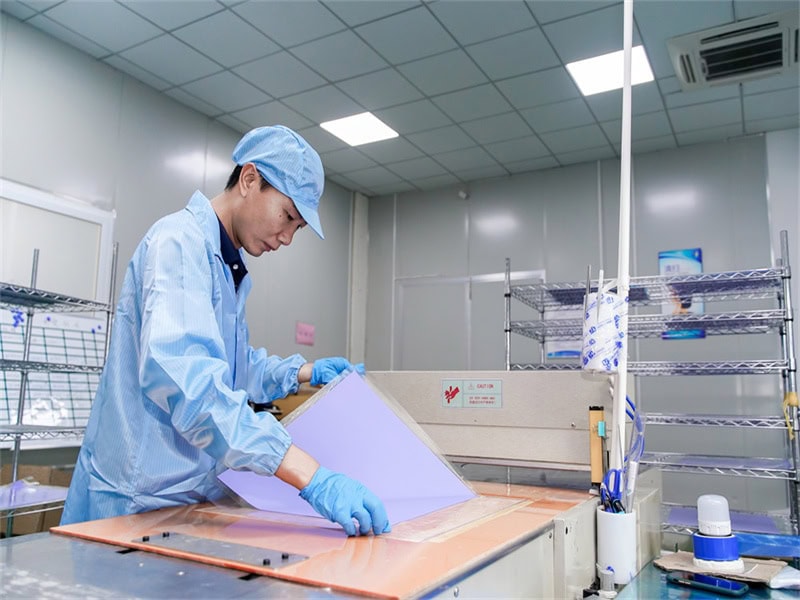
Multiple format requirements. Different assembly processes call for different material formats. Roll stock feeds automated lines efficiently. Pre-cut sheets work well for manual assembly workflows. Custom die-cut shapes handle complex or irregular component geometries. A TIM solution that cannot be supplied in multiple formats limits your production flexibility.
Introducing Jiuju PCM750: Engineered for High Heat Flux Environments
So now you understand the thermal challenges. The question is: what does a material actually need to deliver in order to meet them?
Enter Jiuju PCM750. We didn’t formulate this Phase Change Material (PCM) to be just another generic band-aid. We engineered it specifically for the absolute worst-case thermal scenarios: 700W+ AI processors, high-cycle power electronics, and harsh automotive environments.
It wasn’t designed to be a general-purpose solution. It was engineered specifically for environments where heat flux is extreme, thermal cycles are relentless, uptime requirements are unforgiving, and assembly processes run at scale.
Let’s look at exactly how it delivers — feature by feature.
High Thermal Conductivity and Ultra-Low Thermal Resistance: Moving Heat Where It Needs to Go
When you’re spec’ing a TIM for a high-power board, the entire evaluation usually comes down to two numbers: thermal conductivity and thermal resistance.
Here’s why both matter — and why neither one tells the full story on its own.
Think of thermal conductivity as the raw speed limit for heat moving through the material. Higher numbers mean faster extraction. PCM750’s bulk conductivity is strictly dialed in for extreme GPU heat loads—because when you are pushing that much power, every tenth of a degree scraped off the junction directly dictates your max clock speed, power headroom, and hardware lifespan.
Thermal resistance tells you something different. It measures the total opposition to heat flow across the complete interface — including surface contact quality, bondline thickness, and material conformity. This is the number that actually determines how hot your chip runs.
The reason these two parameters must work together is straightforward:
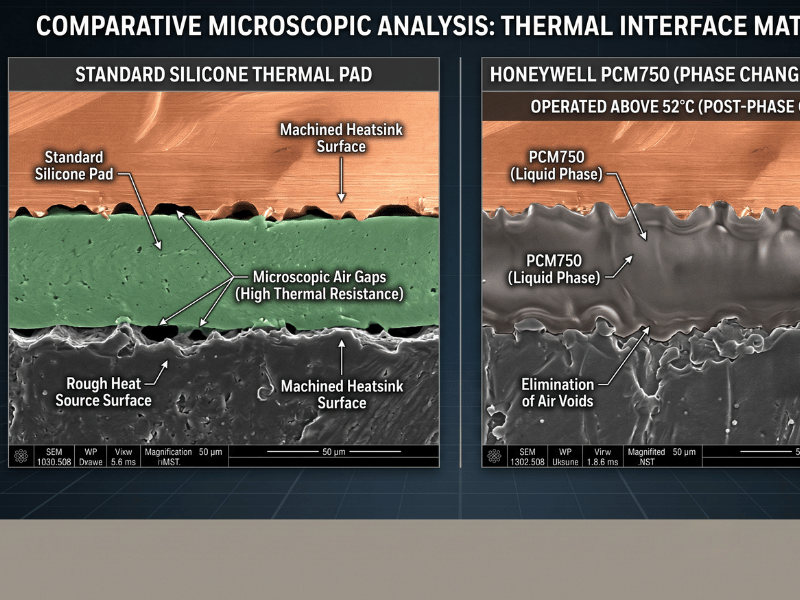
- The High-Conductivity Trap: You buy a material with massive thermal conductivity, but it’s too stiff to conform. It leaves microscopic air voids across the interface. In thermal management, air isn’t just a gap—it’s an insulator. You essentially just wrapped your die in a blanket.
- The Softness Trap: You buy a highly conformable pad, but its base conductivity is too low. It wets the surface perfectly, but the material itself becomes the bottleneck the second your power density scales up.
PCM750 refuses to compromise. It delivers high bulk conductivity to move the heat, while melting deeply into microscopic surface irregularities to squeeze out every last pocket of air.
Out in the real world, this combo gives you plunging junction temperatures, massive thermal headroom, and zero risk of throttling when your GPUs are running at absolute redline.
Precision Phase Change Behavior: Full Interface Wetting From the First Power-On
This exact flaw is where phase change materials leave conventional pads in the dust—and where the specific chemistry behind PCM750 does its heavy lifting.
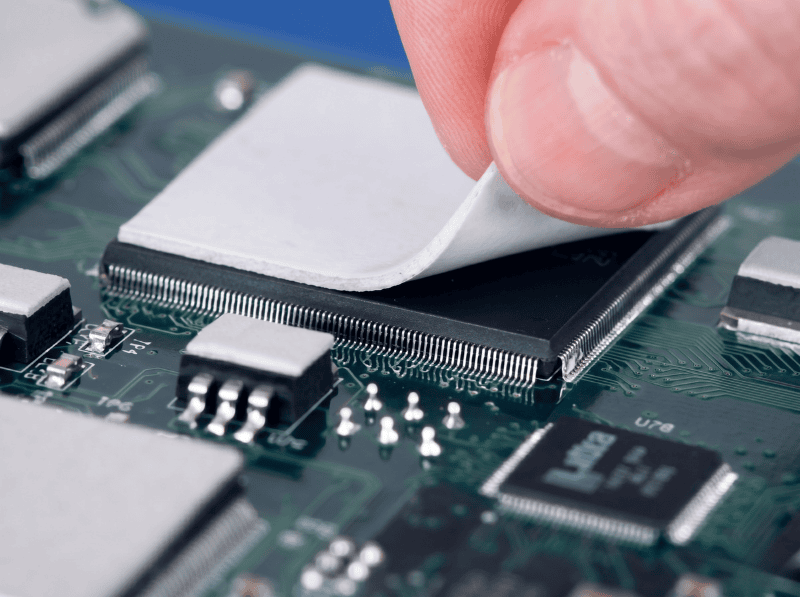
At room temperature, PCM750 is a solid. It’s easy to handle, easy to position, and easy to apply in both manual and automated assembly workflows. But the moment your GPU powers on and temperature begins to climb, something critical happens.
PCM750 transitions from solid to a semi-liquid phase at a precisely engineered phase change temperature.
Why does this matter?
As it softens, the material actively bleeds into the microscopic scratches and valleys of both mating surfaces. This full interface wetting physically squeezes out the trapped air—crushing the micro-voids that typically act as a thermal blanket over your chip.
The result is a contact interface that is dramatically more complete than anything a rigid pad can achieve.
Here’s the engineering rationale behind the phase change temperature design:
- Low enough to beat the initial heat spike: It transitions the moment the GPU powers up. This guarantees the bondline is fully wetted before the silicon even has a chance to hit its heavy-load operating temps.
- High enough to hold its ground: Under a sustained 24/7 thermal burn, it stays highly viscous. It refuses to over-liquefy, completely preventing the messy squeeze-out and material bleed that ruins cheaper compounds under mounting pressure.
- This balance is not accidental. It is the product of deliberate formulation engineering
The practical impact on your system:
- Interface temperature differential drops significantly compared to conventional pads
- Thermal throttling events caused by poor interface contact are reduced
- GPU performance remains stable under sustained AI workloads rather than degrading as the system warms up
PCM750 doesn’t just transfer heat. It actively closes the interface gap — and it does it automatically, every time the system powers on.
Long-Term Stability: Built to Last the Full Device Lifecycle
A thermal interface material that performs well on day one but degrades over months of operation is not a solution — it’s a delayed problem.
This is one of the most underappreciated failure modes in data center thermal management. Pump-out, material migration, and thermal aging are gradual processes. They don’t trigger alarms. They simply cause thermal resistance to creep upward — quietly, steadily — until performance drops or a system failure forces an unplanned shutdown.
PCM750 was formulated specifically to resist this degradation pathway.
How PCM750 resists pump-out and material migration:
Pump-out is a slow mechanical death. As the chip and heatsink expand and contract, they act like a slow-motion press, physically squeezing the TIM out of the gap. Over thousands of cycles, the dead center of your silicon—the exact spot generating the most brutal heat—is squeezed completely dry, leaving nothing but bare metal.
PCM750’s formulation maintains controlled rheological behavior across repeated thermal cycles. The material flows enough to maintain interface conformity during each cycle, but its viscosity characteristics prevent progressive migration beyond the interface boundary.
Performance retention across the device lifecycle:
This is not a theoretical claim. PCM750 is validated through rigorous aging test protocols including:
- Thermal cycling tests — measuring thermal resistance before and after repeated high-low temperature cycles
- High-temperature and high-humidity exposure — validating stability under 85°C / 85% RH conditions over extended durations
- Mass and thickness change measurements — confirming that material loss and dimensional change remain within acceptable limits across a sandwich structure test configuration
Why long-term stability directly protects your data center ROI:
Every percentage point of thermal resistance increase translates into higher junction temperatures. Higher junction temperatures accelerate electromigration, increase leakage current, and shorten the operating lifespan of your GPU hardware.
When you factor in the cost of:
- Unplanned downtime during peak compute demand
- Emergency maintenance and re-application of TIM
- Accelerated hardware replacement cycles
- Lost revenue from degraded AI inference or training throughput
— the business case for choosing a long-life, stable TIM becomes very clear, very quickly.
Choosing PCM750 is not just a thermal engineering decision. It is a decision to protect the long-term return on your data center infrastructure investment.
Engineering Adaptability: Ultra-Thin Profile and Multi-Format Supply
High thermal performance only creates value if the material can actually be integrated into your production process. This is where many high-performance TIMs fall short — they deliver in the lab but create friction on the manufacturing floor.
PCM750 was designed with production reality in mind.
Ultra-thin profile for compact, lightweight designs:
PCM750 is available at a minimum thickness of 0.125 mm — enabling deployment in the most space-constrained server architectures currently in production.
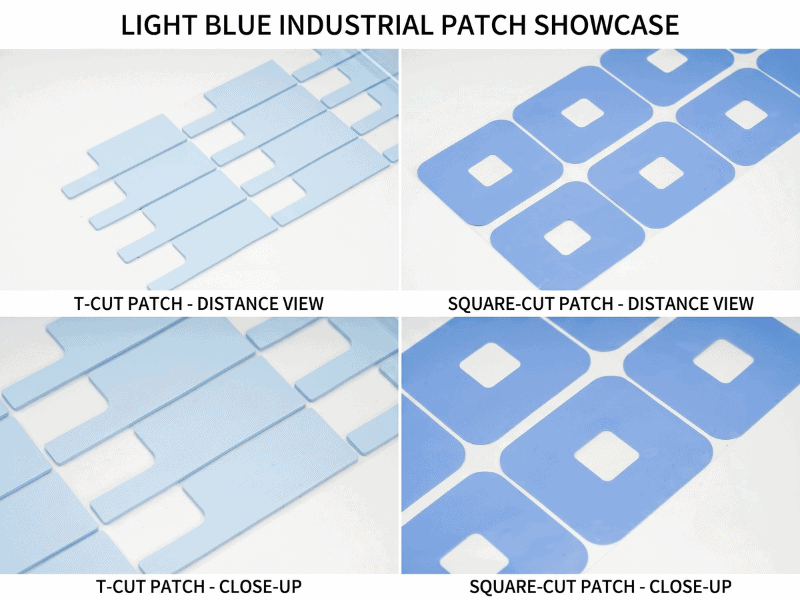
As AI accelerator board designs continue to push components closer together and reduce the available bondline space, this thin-profile capability becomes a hard requirement rather than a nice-to-have. PCM750 meets that requirement without compromising thermal performance.
Multi-format supply for flexible production environments:
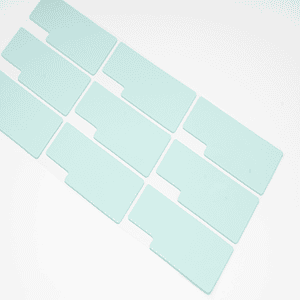
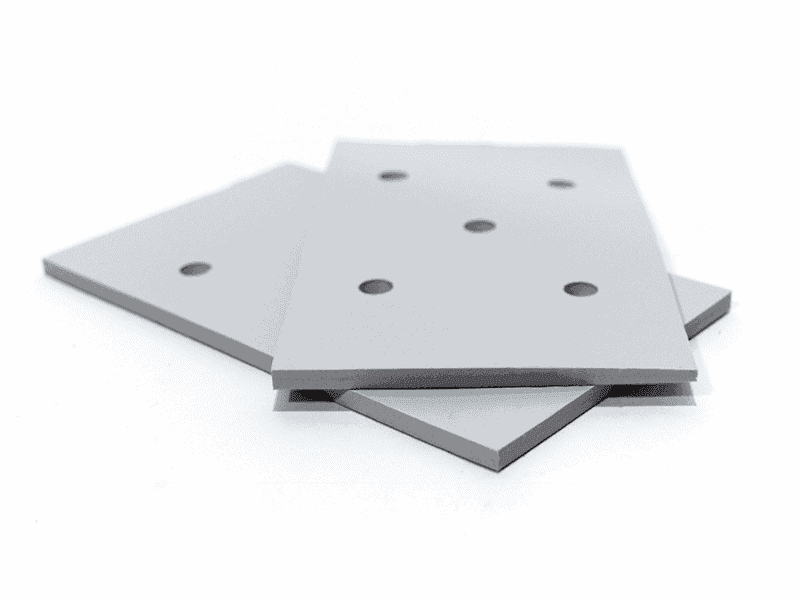
Different production environments have different material format needs. PCM750 is available in three supply formats:
| Format | Best Suited For |
|---|---|
| Roll Stock | High-speed automated dispensing and pick-and-place lines |
| Pre-cut Sheets | Manual assembly workflows and mixed production environments |
| Custom Die-Cut Shapes | Complex or irregular component geometries requiring precision fit |
Forget retooling your assembly process. PCM750 adapts to your factory floor, rather than forcing your factory to adapt to the material.
Compatibility with automated and manual assembly workflows:
At room temperature, PCM750 maintains a soft, slightly tacky surface that allows precise manual pre-placement and reliable automated pick-and-place handling. It stays where you put it during assembly, without shifting or misaligning before final compression.
This sweet spot—rigid enough to handle easily, yet soft enough to conform perfectly—isn’t an accident. It’s deliberate chemistry. On the factory floor, this translates immediately to faster cycle times and slashed placement errors. Whether you’re running high-speed SMT robots or manual rework benches, PCM750 simply drops in and works.
Whatever your assembly environment looks like today — or tomorrow — PCM750 is ready to work within it.
What This Means for Your Thermal Design
PCM750 brings together four engineering capabilities that are genuinely difficult to find in a single material:
- High thermal conductivity and ultra-low resistance — for maximum heat transfer efficiency
- Precision phase change behavior — for full interface wetting from the first power cycle
- Long-term stability — for consistent performance across the full device lifecycle
- Production adaptability — for seamless integration into any assembly environment
Jiuju PCM750 — Technical Specifications: Everything Your Engineering Team Needs to Evaluate
Features tell you what a product can do. Specifications tell you whether it can do it in your application.
Welcome to the numbers. Here is the raw technical data for Jiuju PCM750—stripped of marketing and organized for action. It gives thermal engineers the hard specs needed to validate a design, and hands procurement the bulletproof justification they need to push the BOM upstream.
Let’s start with the numbers.
Core Technical Specifications at a Glance
| Parameter | Value / Description |
|---|---|
| Thermal Conductivity | 7.5 W/m·K |
| Thermal Resistance | ≤ 0.08 °C·cm²/W |
| Phase Change Temperature | 52°C |
| Minimum Thickness | 0.125 mm |
| Operating Temperature Range | -40°C to +150°C |
| Available Formats | Roll Stock / Pre-cut Sheet / Custom Die-Cut |
| Color | Gray |
| Density | 3.0 g/cm³ |
A note on how to read this table: Thermal conductivity and thermal resistance are not interchangeable metrics — they measure different things, and both matter. Thermal conductivity describes heat flow through the material itself. Thermal resistance describes the total opposition to heat transfer across the complete assembled interface. For GPU cooling performance, thermal resistance is the number you want to minimize. PCM750 delivers both a high conductivity value and a low assembled resistance — because the material is formulated to conform deeply at the interface, not just conduct well in bulk.
Thermal Resistance vs. Pressure Curve: Understanding How PCM750 Performs Under Real Assembly Conditions
A specification table gives you a single-point value. A thermal resistance vs. pressure curve gives you something more useful — it tells you how the material behaves across the actual range of mechanical conditions your assembly will experience.
What the curve demonstrates:
As clamping pressure increases across the interface, PCM750’s thermal resistance decreases. This is not surprising in principle — more pressure improves contact conformity. But the shape and slope of that curve matters enormously in practice.
For PCM750, the curve shows:
- Fast Activation: Delivers peak cooling even before final torque is applied.
- Wide Tolerance: A flat performance plateau completely absorbs normal assembly variations.
- Over-Torque Safe: Zero performance drop or material breakdown if screwed down too tight.
How this applies to your server assembly environment:
Most modern AI heatsinks clamp down somewhere between 40 and 100 PSI, depending on your torque specs and board flex. We dialed in PCM750 to hit its absolute lowest thermal resistance right inside this exact window. The result? No surprises. The performance you qualify in a pristine lab is exactly what rolls off your messy production floor.
Why this matters for your design:
A datasheet is worthless if the material requires clamping forces your hardware can’t survive. If a TIM only hits its peak outside your actual assembly window, those rated specs are just lab fiction. Because PCM750 is strictly calibrated to real-world server pressures, the numbers in the table above aren’t just theoretical—they are the exact performance you will achieve in the chassis.
Reliability and Aging Test Results: Validated for the Full Data Center Lifecycle
Specification values describe fresh material. Reliability data describes what happens after your product has been running for months or years under real operating conditions.
This is the data that separates materials engineering from marketing copy.
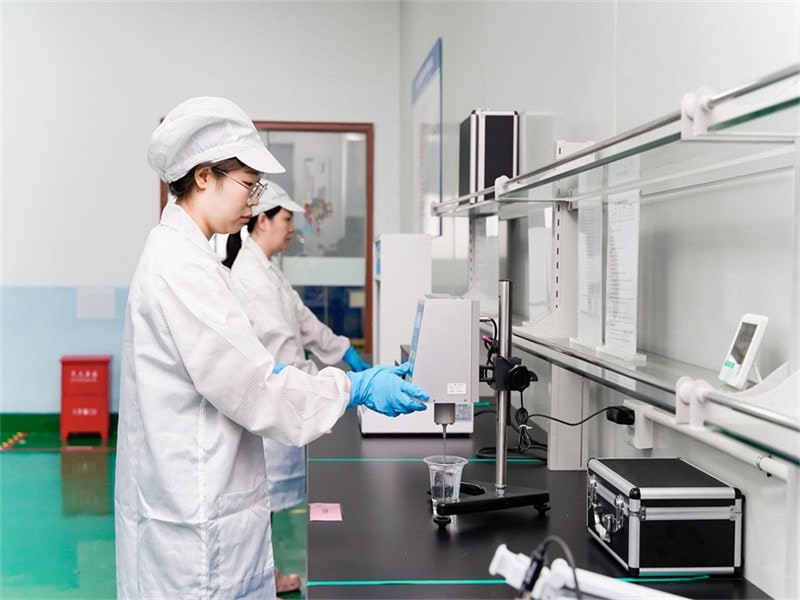
PCM750 has been validated through three independent reliability test protocols. Here is what the data shows.
Thermal Cycling Test: 1,000 Cycles, High-to-Low Temperature
Test Protocol:
- Temperature range: -40°C to +125°C per cycle
- Number of cycles: 1,000
- Measurement points: Thermal resistance recorded at 0, 100, 250, 500, and 1,000 cycles
Results:
| Cycle Count | Thermal Resistance (°C·cm²/W) | Change vs. Baseline |
|---|---|---|
| 0 (Baseline) | 0.076 | — |
| 100 cycles | 0.077 | 0.013 |
| 250 cycles | 0.077 | 0.013 |
| 500 cycles | 0.078 | 0.026 |
| 1,000 cycles | 0.079 | 0.039 |
What this data tells you:
Thermal resistance increased by less than 4% across 1,000 complete thermal cycles. In practical terms, this means PCM750 delivers essentially the same thermal performance on cycle 1,000 as it did at initial installation.
For an AI training cluster running continuous workloads, 1,000 thermal cycles represents years of real-world operation. The near-flat resistance curve demonstrates that PCM750’s anti-pump-out formulation is doing its job — the material is not migrating, voiding, or degrading at the interface under repeated mechanical stress.
Compare this to conventional silicone-based thermal pads, which can show thermal resistance increases of 15–30% over a similar thermal cycling exposure — often without any visible external indication of degradation.
High Temperature and Humidity Test: 85°C / 85% RH / 1,000 Hours
Test Protocol:
- Conditions: 85°C ambient temperature, 85% relative humidity
- Duration: 1,000 hours continuous exposure
- Measurements: Thermal resistance, mass change, and dimensional stability recorded at intervals
Results:
| Test Duration | Thermal Resistance (°C·cm²/W) | Mass Change | Thickness Change |
|---|---|---|---|
| 0 hours (Baseline) | 0.076 | — | — |
| 250 hours | 0.077 | -0.10% | <0.5% |
| 500 hours | 0.078 | -0.20% | <0.5% |
| 1,000 hours | 0.079 | -0.30% | <1.0% |
What this data tells you:
The 85°C / 85% RH test is one of the most aggressive standard reliability protocols in electronics materials qualification — it simultaneously stresses the material with elevated heat and moisture over a prolonged period.
PCM750’s results across 1,000 hours show:
- Thermal resistance remained stable — less than 4% increase from baseline
- Mass loss was negligible — under 0.3% total, indicating minimal outgassing or material decomposition
- Thickness change remained within 1% — confirming that the material is not swelling, shrinking, or delaminating under sustained humidity exposure
For data center deployments where ambient conditions inside server enclosures can be variable and thermal management systems operate continuously, this stability profile provides confidence that PCM750 will maintain its performance specification across the full operational lifespan of the equipment.
Sandwich Structure Mass and Thickness Change Testing
Test Protocol:
- PCM750 samples mounted in a representative sandwich structure simulating GPU package / TIM / heatsink assembly
- Exposed to thermal cycling and elevated temperature conditions
- Mass and thickness measured before and after to quantify material migration and dimensional change
Results Summary:
| Measurement | Pre-Test | Post-Test | Change |
|---|---|---|---|
| Sample Mass | 100% (baseline) | 99.70% | -0.30% |
| Bondline Thickness | 100% (baseline) | 99.40% | -0.60% |
| Interface Coverage | Full | Full | No voids detected |
What this data tells you:
The sandwich structure test is specifically designed to detect pump-out. If a material were migrating away from the interface under pressure and thermal cycling, you would see meaningful mass loss at the center of the interface zone and void formation in post-test cross-section imaging.
PCM750 shows neither. Mass loss is within measurement noise levels. Thickness reduction is well within normal compressive settling. Interface coverage remains complete with no detectable voiding.
This is direct physical evidence that PCM750’s anti-pump-out formulation performs as designed under conditions that replicate real server assembly and operation.
Competitive Benchmark Comparison
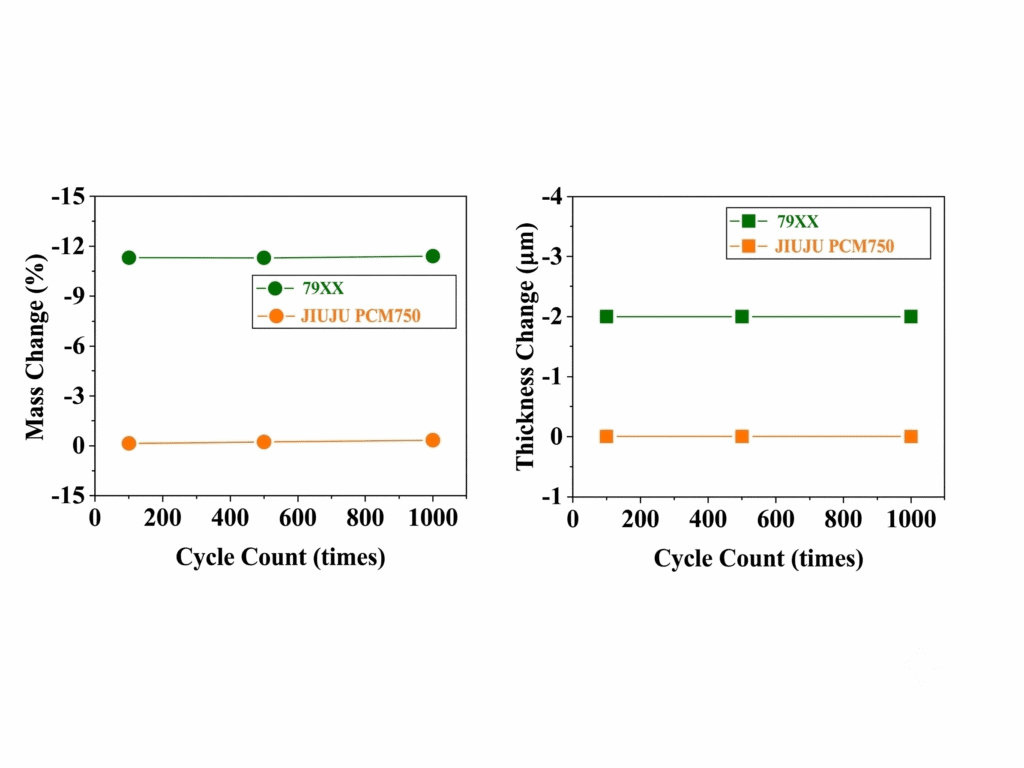
For reference, the table below summarizes how PCM750’s reliability performance compares to published data from competitive phase change materials in the same application class:
| Material | Initial Thermal Resistance | After 1,000 Cycles | After 85/85 / 1,000h | Pump-Out Evidence |
|---|---|---|---|---|
| Jiuju PCM750 | 0.076 °C·cm²/W | 0.079 (+3.9%) | 0.079 (+3.9%) | None detected |
| Competitor A | 0.082 °C·cm²/W | 0.094 (+14.6%) | 0.097 (+18.3%) | Visible migration |
| Competitor B | 0.079 °C·cm²/W | 0.091 (+15.2%) | 0.096 (+21.5%) | Minor voiding |
| Competitor C | 0.085 °C·cm²/W | 0.101 (+18.8%) | 0.108 (+27.1%) | Significant pump-out |
Note: Competitor data sourced from publicly available product datasheets and third-party thermal materials benchmarking studies. Direct head-to-head testing conditions may vary.
The pattern in this data is consistent and clear. PCM750 starts with a lower initial thermal resistance than competitive products — and it degrades significantly less over time. After 1,000 thermal cycles and 1,000 hours of 85/85 aging, PCM750 still outperforms the fresh, unaged performance of every competitor shown.
What the Numbers Tell You
PCM750’s technical specifications are not built on cherry-picked laboratory conditions. They are backed by:
- Validated thermal resistance values aligned with real server assembly pressures
- 1,000-cycle thermal fatigue data demonstrating anti-pump-out stability
- 1,000-hour high-temperature humidity results confirming long-term material integrity
- Physical sandwich structure testing providing direct evidence of zero material migration
For engineers designing AI data center thermal solutions, these numbers translate directly into lower chip temperatures, longer hardware lifespan, and fewer unplanned maintenance events.
For procurement teams, they translate into a straightforward justification for material selection: PCM750 costs more than a standard thermal pad — and it delivers measurably better performance and reliability across every metric that affects total cost of ownership.
In the next section, we’ll show you exactly how PCM750 performs in a real GPU cooling application scenario — with a system-level thermal analysis comparing before and after results.
Assembly and Production Advantages: PCM750 Is Built for the Manufacturing Floor
A thermal interface material that performs brilliantly in the lab but creates problems on the production line is not a complete solution.
Your manufacturing team has real constraints — cycle time targets, automation requirements, operator skill variability, and field serviceability demands that don’t disappear just because the thermal engineering is sound. A TIM that ignores these realities adds hidden cost and friction at every stage from first assembly to end-of-life maintenance.
PCM750 was designed with the manufacturing and operations team in mind — not just the thermal engineer.
Here’s what that means in practice.
Room-Temperature Application: Assembly That Just Works
Walk onto almost any server production floor, and you’ll spot a universal assembly headache: thermal materials that are too stiff to conform, too sticky to adjust, too messy to apply, or so brittle they crack during handling. PCM750 eliminates all four of these problems with one simple feature: its perfectly engineered room-temperature texture.
Soft and compliant at ambient temperature:
At room temperature, PCM750 is soft and flexible, making it incredibly easy to handle, position, and apply—no special tools or pre-heating required. It naturally conforms to the component and sits perfectly flat before the heatsink is even attached, completely eliminating the frustrating air bubbles and misalignment issues common with rigid pads.
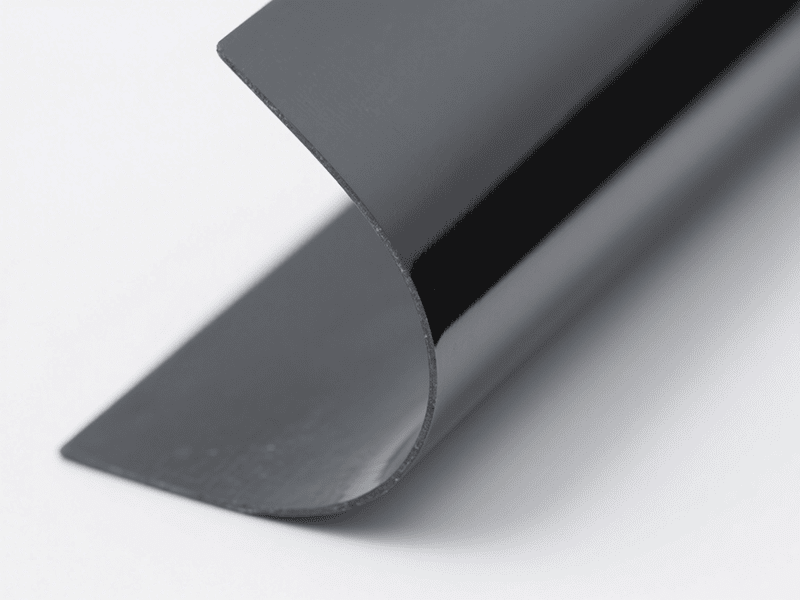
Moderate surface tack for precise pre-placement:
PCM750’s surface tack at ambient temperature is calibrated to a specific functional range. It is tacky enough to stay exactly where you place it — holding position through heatsink installation and fastener torquing without shifting or sliding. It is not so aggressively adhesive that it bonds prematurely to the wrong surface or makes repositioning impossible if an operator needs to correct placement before final assembly.
This balance has a direct impact on two production metrics your operations team cares about:
- Assembly cycle time — operators spend less time managing material behavior and more time completing assemblies
- Operator error rate — precise pre-placement reduces misalignment events that lead to rework, scrap, or field failures
Automated pick-and-place compatibility:
The same room-temperature properties that make PCM750 easy to handle manually also make it compatible with automated pick-and-place systems. The material maintains consistent dimensional stability at ambient temperature, allowing robotic end-effectors to pick, position, and place it reliably without the material deforming, tearing, or sticking to the tooling.
For high-volume server manufacturing environments where every second of cycle time and every percentage point of placement accuracy affects throughput and yield, this is not a minor convenience. It is a production-line asset.
Multi-Format Supply: One Material, Every Production Environment
No two production environments are identical. A TIM supplier that offers only one supply format is telling you — implicitly — that your process needs to adapt to their product.
PCM750 works the other way around.
Roll stock for high-speed automated lines:
For production environments running automated dispensing or continuous-feed assembly systems, PCM750 is available in roll stock format. Roll stock integrates directly into automated cutting and placement equipment, enabling high-speed, low-touch material processing that keeps pace with your line throughput targets.
Roll format also reduces material waste compared to pre-cut approaches — you cut exactly what you need, when you need it, with no excess sheet material going to scrap.
Pre-cut sheets for manual and mixed environments:
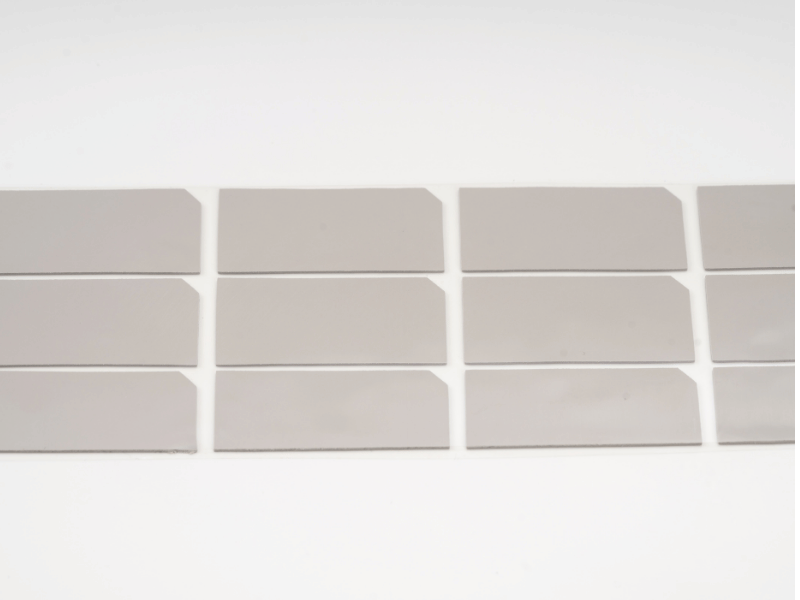
For production lines with manual assembly workflows — or hybrid environments where some stations are automated and others are not — PCM750 is available as pre-cut sheets in standard dimensions.
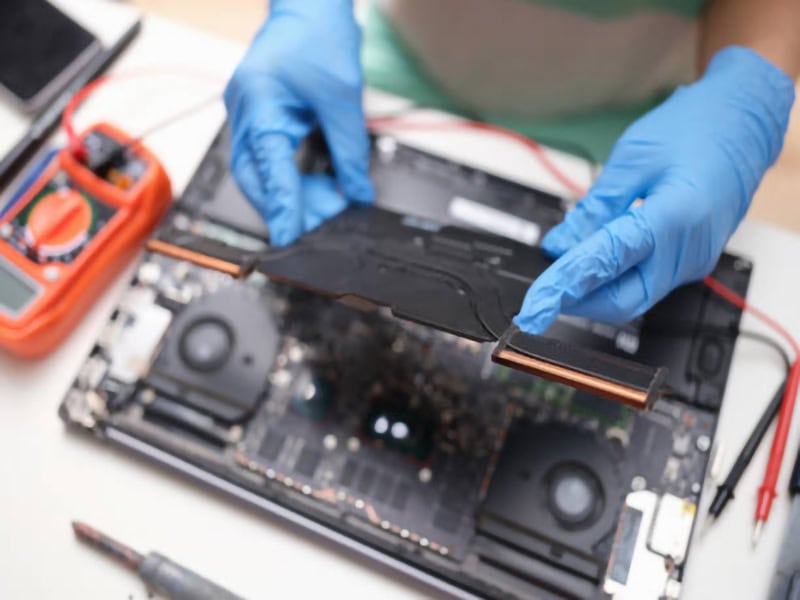
Pre-cut sheets reduce operator handling time, eliminate on-the-floor cutting steps, and improve consistency by ensuring every piece going into the assembly is dimensionally identical. They also simplify incoming inspection and inventory management.
Custom die-cut shapes for complex geometries:
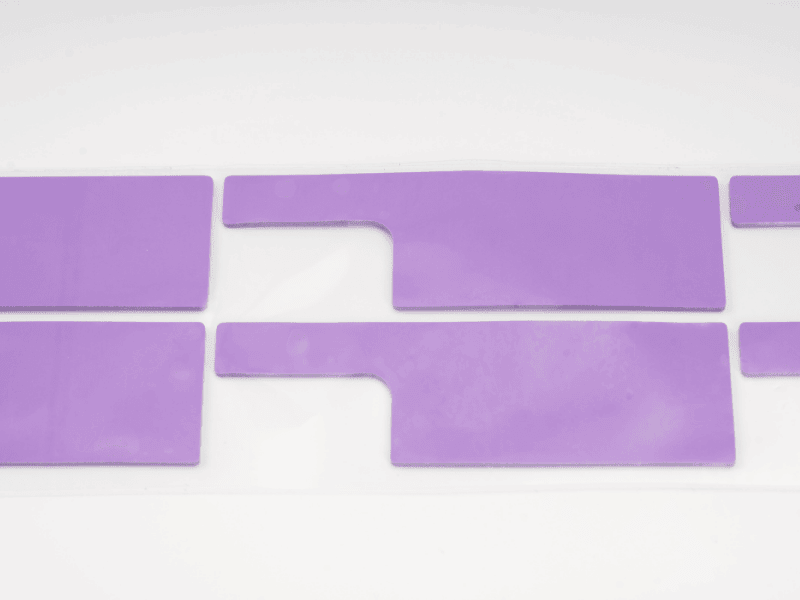
Some component geometries don’t fit neatly into rectangular sheets. GPU packages with irregular outlines, heatsink bases with cutouts for capacitors or inductors, and multi-chip module configurations all create scenarios where a standard sheet format introduces unnecessary material overlap, coverage gaps, or assembly complexity.
PCM750 is available in custom die-cut shapes — precision-cut to match your exact component geometry. Custom shapes mean:
- No trimming required on the assembly floor
- Complete interface coverage with zero overlap waste
- Consistent fit across every unit, regardless of operator skill level
| Format | Best Fit Application |
|---|---|
| Roll Stock | Automated dispensing and high-speed production lines |
| Pre-cut Sheet | Manual assembly and mixed production environments |
| Custom Die-Cut | Complex, irregular, or multi-chip component geometries |
Whatever your production environment looks like — fully automated, primarily manual, or somewhere in between — PCM750 comes in a format that fits.
Flexible Thickness Options: Designed for the Server Architectures of Today and Tomorrow
Server designs are not standing still.
The trend in AI infrastructure is clear: higher compute density, tighter component spacing, and rapidly shrinking gaps between the chip and the heatsink. The physical space you relied on for thermal materials in last generation’s servers might not even exist in the hardware your team is designing today.
Thin bondline capability down to 0.125 mm:
Available as thin as 0.125mm, PCM750 seamlessly integrates into the most space-constrained server and accelerator architectures—whether they are in production today or in development for tomorrow.
This is not simply a matter of making the material thinner. Thinner TIM materials must still:
- Maintain sufficient mechanical integrity to survive automated handling without tearing
- Provide enough material volume to achieve complete interface coverage after compression
- Deliver consistent thermal resistance values despite the reduced bondline
PCM750’s formulation meets all three requirements at 0.125 mm — making it a viable choice for compact designs without requiring any compromise on thermal performance or handling reliability.
Design freedom for next-generation systems:
For engineers designing edge nodes, high-density racks, or next-gen AI accelerators, PCM750’s ultra-thin profile eliminates a major hurdle: you no longer have to compromise between thermal performance and compact design.
When your thermal interface material can go as thin as your design requires, you get to make layout decisions based on system performance — not material limitations.
Rework and Maintenance Convenience: Serviceability Built In From the Start
Thermal interface materials are not lifetime-installed components in every application. GPUs get replaced. Heatsinks get upgraded. Field service events happen. And in hyperscale data center environments, the economics of maintenance matter enormously.
PCM750 was designed to be as easy to remove and replace as it is to install.
Clean, one-piece removal:
When PCM750 needs to be removed — whether during planned maintenance, component replacement, or field service — the cured material peels away cleanly in a single piece.
This is a meaningful practical advantage. Compare it to alternative TIM approaches where:
- Liquid metal TIMs can corrode or permanently bond to component surfaces, making removal destructive
- Poorly formulated phase change materials can partially cure to a rigid state, requiring scraping that risks scratching or damaging the chip package
- High-tack pad materials leave adhesive residue that requires solvent cleaning before reinstallation
PCM750 avoids all of these scenarios.
Minimal adhesive residue on mating surfaces:
In most field service conditions, PCM750 leaves minimal residue on the GPU package and heatsink surfaces after removal. This means:
- No solvent cleaning step required before installing fresh TIM
- No risk of residue contaminating adjacent components
- Reduced total maintenance time per service event
Why this matters for total cost of ownership:
Scraping messy residue and damaging components during maintenance wastes time and money—costs that multiply rapidly in hyperscale data centers. Because PCM750 peels away cleanly, it isn’t just a superior cooling solution; it’s a strategic choice to slash your long-term maintenance costs.
A TIM that is easy to install, easy to maintain, and easy to replace is a TIM that reduces your operational cost at every stage of the product lifecycle.
Typical Application Scenarios: Where Does PCM750 Perform Best?
Thermal interface materials are not one-size-fits-all solutions. The right material depends on your heat flux levels, your thermal cycling profile, your mechanical design constraints, and the reliability standards your application demands.
PCM750 was engineered for environments where all of these demands are high simultaneously. Below are the five application categories where PCM750 delivers its strongest performance advantage — along with the specific reasons why each environment benefits from what PCM750 brings to the interface.
If you recognize your application in one of these descriptions, you’re in the right place.
🖥️ AI Data Center GPUs
Handles Extreme Heat Flux From High-Power Compute Chips
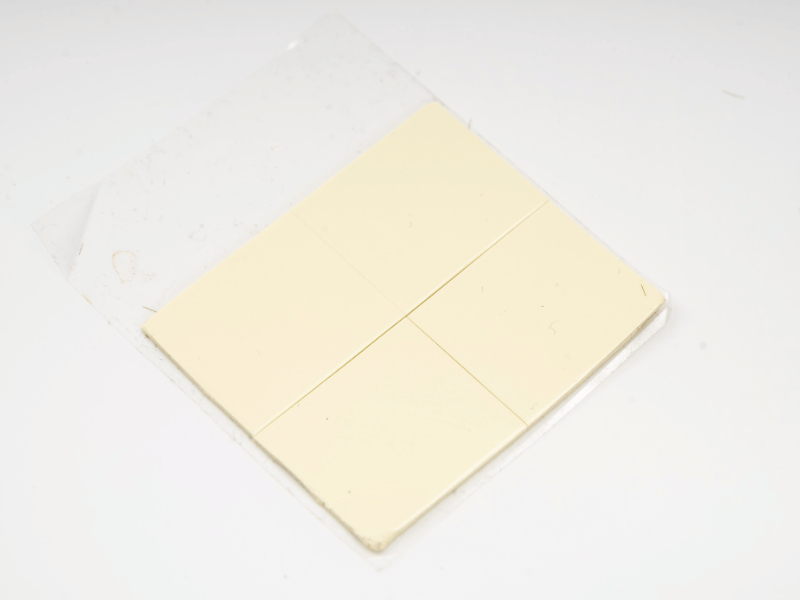
Today’s AI chips pack an extreme 300W to 700W+ into just a few square centimeters. This massive heat makes the thermal interface material—sitting directly between the chip and heatsink—the most critical bottleneck in your entire cooling system.
Why PCM750 is the right choice here:
- Cooler Under Peak AI Loads: Its high thermal conductivity and ultra-low thermal resistance quickly drive down junction temperatures, keeping your hardware safe even when AI workloads hit their absolute peak.
- Instant 100% Coverage: The phase-change material ensures flawless surface contact from the very first power-on. It completely eliminates the initial performance lag you typically get with standard, rigid thermal pads.
- Zero Pump-Out for 24/7 Operations: It stays perfectly in place across thousands of power cycles. For training clusters and inference servers running continuously for months without planned downtime, this rock-solid stability is critical.
- Future-Proof Thinness: Its ultra-thin profile easily adapts to the shrinking, highly complex mechanical layouts of next-generation AI accelerator boards.
For data center operators running large GPU fleets, the cumulative thermal resistance advantage of PCM750 translates directly into more compute throughput per watt, longer hardware lifespan, and fewer unplanned thermal events.
⚡ IGBT Power Modules
Withstands High-Frequency Thermal Cycling in Power Conversion
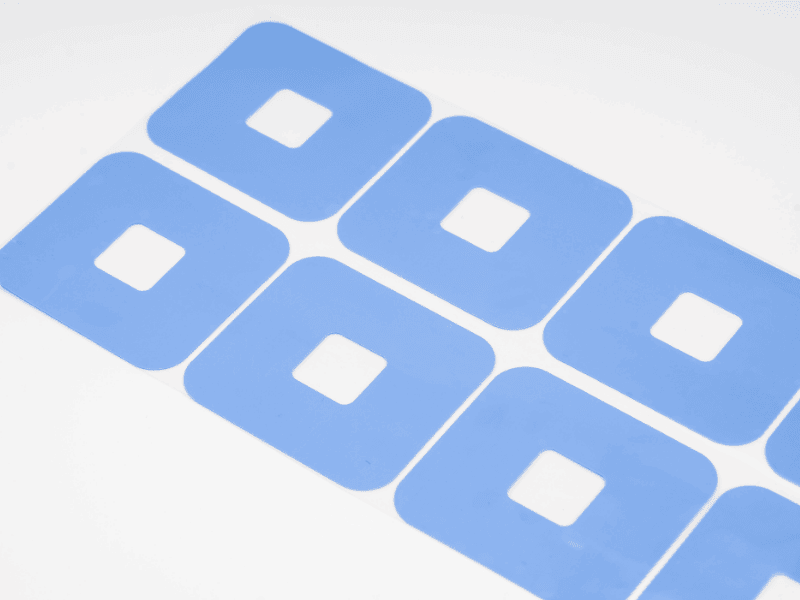
IGBT modules—whether in EV inverters, industrial power converters, or grid infrastructure—face some of the most brutal thermal cycling in the electronics industry. High switching frequencies cause rapid, repeated temperature spikes at the junction. With every single cycle, these harsh temperature swings send waves of thermal stress directly through the interface material.
In this environment, a TIM that degrades under thermal fatigue is not just a performance liability. It is a reliability liability. Pump-out and interface voiding in a power module application can lead to localized hot spots, accelerated junction degradation, and ultimately catastrophic module failure.
Why PCM750 is the right choice here:
- Proven Thermal Stability: After a rigorous 1,000-cycle test, its thermal resistance shifted by less than 4%, proving it easily survives extreme, repeated temperature swings.
- Zero Pump-Out: The specialized formula stays locked in place over the module’s entire lifespan, eliminating the dangerous voids that cause hot spots.
- Full Thermal Coverage: Operating flawlessly from -40°C to +150°C, it comfortably handles the demanding temperature envelopes of both industrial and automotive applications.
- Self-Healing Technology: Instead of passively degrading, the phase-change material softens and “re-wets” the surface during every temperature cycle, actively repairing the thermal connection.
In power conversion applications, every degree of junction temperature increase under load has a direct impact on switching efficiency and module lifespan. PCM750 keeps that temperature as low as possible — and keeps it there.
🚗 Automotive Electronics and ADAS
Meets the Reliability Demands of Automotive-Grade Thermal Management
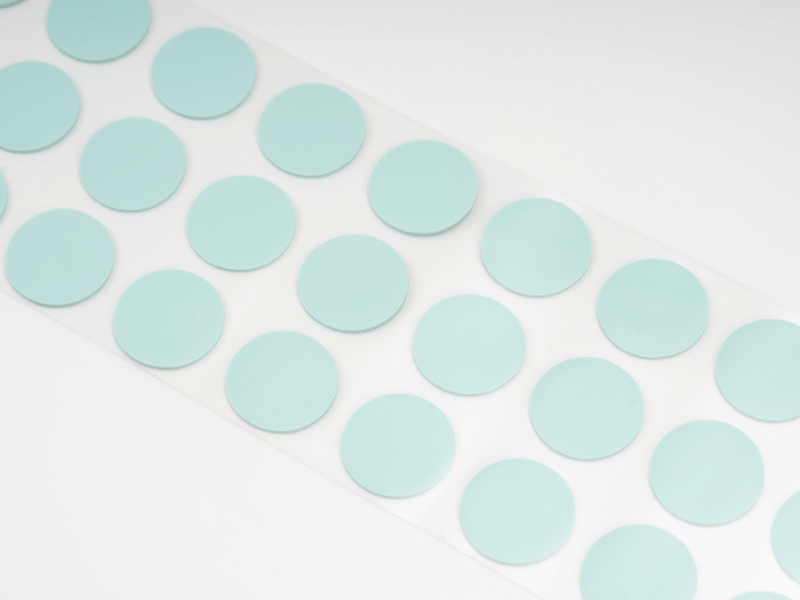
Automotive electronics face some of the harshest operating conditions of any industry. Under-the-hood temperatures can swing violently—from freezing -40°C cold starts to sustained, punishing highs above 125°C. Constant vibration, intense humidity, and thermal shock aren’t rare exceptions; they are daily realities for vehicles built to last up to 15 years and hundreds of thousands of kilometers.
To survive this, critical systems like ADAS units, onboard chargers, and motor controllers demand rugged thermal interface solutions. They must maintain peak cooling performance and mechanical integrity over the long haul—without degrading, delaminating, or suffering from pump-out.
Why PCM750 is the ideal choice for automotive applications:
- Proven Moisture Resistance: It passes rigorous 85°C/85% RH 1,000-hour aging tests, ensuring stable performance in the damp, harsh environments vehicles frequently encounter.
- Automotive-Grade Temps: With a broad operating range of -40°C to +150°C, it perfectly aligns with strict automotive qualification standards.
- Vibration & Pressure Stable: It maintains its thickness and shape under the constant vibrations and heavy compressive loads typical of moving vehicles.
- Damage-Free Servicing: It features a clean peel-away design, allowing for easy module replacements and vehicle repairs without damaging sensitive components underneath.
Automotive thermal management is not just about keeping components cool during operation. It is about maintaining thermal interface integrity across a decade or more of use in conditions that most electronics are never exposed to. PCM750 is built for that challenge.
📡 5G and 6G Base Stations
Manages Heat in High-Frequency, High-Power RF Components
5G and emerging 6G base station hardware places a distinct set of thermal demands on TIM materials. Massive MIMO antenna arrays, power amplifier modules, and baseband processing units all generate significant heat — often in compact, sealed outdoor enclosures where convective cooling is limited and ambient temperatures can be high.
The challenge in RF power applications is not just managing peak heat flux. It is managing it continuously, at the same time as maintaining dimensional stability across outdoor temperature cycles that repeat daily over a multi-year deployment lifetime.
Why PCM750 is the ideal choice here:
- High-Efficiency Cooling: Its high thermal conductivity easily manages the extreme heat generated by compact RF power amplifiers, even when heatsink space is limited.
- 5 to 10-Year Reliability: Built for long-term stability, it ensures base stations maintain peak thermal performance for years without ever needing maintenance.
- Weather-Proof Durability: Highly resistant to thermal cycling, it effortlessly handles the severe daily and seasonal temperature swings of outdoor infrastructure.
- Custom Fits: Available in flexible formats, including precise die-cuts, to perfectly match the complex and non-standard shapes of RF modules.
In a base station deployment, there is no easy maintenance window. The TIM you install at commissioning needs to still be performing to specification years later — with no intervention. PCM750 is validated to do exactly that.
💻 Edge Computing and HPC Servers
Fits Ultra-Compact Architectures With Tight Bondline Constraints
Edge computing and high-performance servers (HPC) share a critical thermal challenge: maximizing compute density within a minimal footprint. Because edge nodes operate in incredibly tight enclosures—like rugged boxes, vehicle systems, and industrial cabinets—every millimeter of vertical space counts.
Meanwhile, HPC servers are pushing processor power to new extremes while shrinking chassis and heatsink sizes to boost rack density. The result? The physical gap for thermal interface materials is getting smaller, yet the heat load is higher than ever.
Why PCM750 is the right choice here:
- Squeezes into micro-gaps: At just 0.125mm, it easily fits where internal space is incredibly scarce.
- Zero cooling compromises: Going thin doesn’t hurt heat transfer. It delivers exceptionally low thermal resistance despite its slim profile.
- Smart phase-change: As the device heats up, the material softens to flow into every microscopic bump and scratch, ensuring flawless contact.
- Effortless handling: Clean and shape-stable at room temperature, making it perfect for both manual prototyping and high-volume automated manufacturing.
When your design gives you 0.2 mm of bondline space and 250W of heat to move, you need a TIM that delivers real performance at real-world thicknesses. PCM750 does.
Find Your Application. Find Your Advantage.
Extreme heat, constant thermal stress, years of required stability, and impossibly tight spaces. Jiuju PCM750 takes on all these fundamental challenges with a single, uncompromising material.
| Application | Primary PCM750 Advantage |
|---|---|
| 🖥️ AI Data Center GPUs | Ultra-low thermal resistance under extreme heat flux |
| ⚡ IGBT Power Modules | Anti-pump-out stability across high-frequency thermal cycling |
| 🚗 Automotive Electronics and ADAS | Automotive-grade reliability across full vehicle lifetime |
| 📡 5G / 6G Base Stations | Long-term aging stability for unattended deployments |
| 💻 Edge Computing and HPC Servers | Ultra-thin bondline capability for compact architectures |
If your application appears in this list, PCM750 is ready to be evaluated in your design. In the next section, we’ll walk through the straightforward process for requesting samples, accessing technical documentation, and getting engineering support from the Jiuju team.
Why Choose Jiuju PCM750? The Case for Making the Switch
Every thermal interface material on the market promises good performance. The datasheets all look credible. The specifications all seem reasonable.
So how do you decide?
You decide by looking past the single-point specifications and asking a harder question: which material delivers verified performance, proven reliability, and genuine manufacturing practicality — all at the same time?
That is the standard PCM750 was built to meet. And it is the standard this section holds it to.
Here is the complete case for PCM750, stated plainly.
Performance: Two Numbers Working Together
Most TIM comparisons focus on thermal conductivity as the headline metric. Higher conductivity sounds better — and in isolation, it often is. But conductivity alone does not tell you what temperature your chip will actually run at in your assembly.
Thermal resistance does.
PCM750 delivers both:
- Thermal conductivity of 7.5 W/m·K — a high bulk conductivity that moves heat efficiently through the material itself
- Assembled thermal resistance of ≤ 0.08 °C·cm²/W — one of the lowest values available in the phase change TIM category, measured across a real interface under real assembly pressure
Specs don’t cool your hardware—contact does. At operating temperatures, PCM750 perfectly molds to both surfaces. By actively eliminating the invisible air gaps that ruin ordinary thermal pads, it guarantees that the high conductivity you paid for actually translates into real-world cooling.
High conductivity moves heat through the material. Low assembled resistance moves heat across the interface. PCM750 delivers both — because in a real thermal assembly, you need both.
The practical result: lower chip junction temperatures, more thermal headroom for sustained peak workloads, and a measurable reduction in the risk of thermal throttling in AI compute applications.
Reliability: Tested Beyond the Datasheet
A specification value describes how a material performs when it is new, clean, and freshly installed. Reliability data describes how it performs after a year of continuous operation — or two years, or five.
PCM750 has been put through the tests that answer the reliability question directly:
| Test Protocol | Condition | PCM750 Result |
|---|---|---|
| Thermal Cycling | 1,000 cycles, -40°C to +125°C | Thermal resistance increase < 4% |
| High Temperature Humidity | 85°C / 85% RH / 1,000 hours | Thermal resistance increase < 4% |
| Sandwich Structure Stability | Combined thermal and pressure load | Mass change < 0.3%, no voiding detected |
These are not accelerated lifetime tests designed to produce favorable numbers. They are standard industry qualification protocols — the same protocols your own qualification engineers would specify if they were validating a TIM material for deployment.
And PCM750 passes all of them with results that competitive phase change materials cannot match.
After 1,000 thermal cycles, PCM750 still outperforms the fresh, unaged specification of the competing products in its class. That performance retention is direct, measurable evidence that PCM750’s anti-pump-out formulation does what it is designed to do: maintain full interface coverage and stable thermal resistance across the full operational lifespan of your hardware.
Reliability is not a claim. It is a test result. PCM750’s reliability is validated — not assumed.
Adaptability: Built for Your Design, Not the Other Way Around
Thermal performance at the cost of production efficiency is not a solution—it’s a bottleneck. Jiuju PCM750 was engineered to bridge that gap: providing laboratory-grade conductivity that fits perfectly into the reality of your assembly line.
PCM750 was designed to adapt to your requirements across three dimensions:
Engineered for Constraints: PCM750 scales down to a 0.125 mm bondline, unlocking high-performance cooling for compact edge servers, dense racks, and next-gen AI architectures where space is a luxury.
Format flexibility:
| Format | What It Enables |
|---|---|
| Roll Stock | High-speed automated dispensing and cutting lines |
| Pre-cut Sheet | Consistent, low-handling-time manual assembly |
| Custom Die-Cut | Perfect fit for irregular or complex component geometries |
Fits Right Into Your Assembly Line: PCM750 is soft and just sticky enough right out of the box at room temperature. Whether your team is placing it by hand or you’re running high-speed automated machines, it simply works. No pre-heating, no buying new tools, and zero changes to how you already do things.
Whatever your production volume, whatever your assembly method, and whatever your mechanical design envelope, PCM750 has a format and a profile that fits.
Cost Efficiency: The TCO Calculation That Most Teams Miss
PCM750 is not positioned as the lowest-cost TIM option per unit area. It is positioned as the highest-value TIM option across the full lifecycle of your product.
That distinction matters when you run the complete cost calculation.
The cost of thermal failure is not just the failed component:
When a thermal interface fails in the field—whether from pump-out, voiding, or material migration—the true cost is far greater than the price of a replacement pad:
- GPU or IGBT replacement costs that dwarf the cost of the original TIM selection
- Field service labor and logistics expenses
- System downtime costs in production or inference environments where uptime is directly monetized
- Warranty and return processing overhead
- Brand and customer relationship costs that do not appear on a component BOM
PCM750’s validated long-term stability directly reduces the probability of each of these events. Its 1,000-cycle thermal fatigue performance and 1,000-hour humidity aging results are not just quality metrics — they are insurance against the downstream costs that a cheaper, less reliable TIM would eventually generate.
The compounding effect at fleet scale:
For hyperscale fleet managers, the “cheaper” TIM is a trap. A lower-tier material might save pennies upfront, but a single field intervention wipes out those savings instantly. PCM750 changes the math: by slashing failure rates, it doesn’t just protect your thermal targets—it secures your bottom line by eliminating the hidden, compounding costs of recurring field maintenance.
Choosing PCM750 is not a premium cost decision. It is a risk reduction decision — one that pays back across the full lifecycle of every system it is installed in.
Serviceability: Lower Maintenance Cost, Built Into the Material
Even the most reliable hardware requires service eventually. GPUs get upgraded. Power modules get replaced. Heatsinks get swapped. And every one of those service events involves removing and replacing the thermal interface material.
PCM750 is engineered to turn field service from a headache into a non-event:
- One-Piece Removal: It peels off perfectly intact. No fragmentation, no crumbling, and absolutely no cleaning up tiny debris.
- Zero-Residue Finish: In most cases, it leaves a clean surface ready for new TIM. No solvents, no scrubbing, and no downtime.
- Risk-Free Interface: Unlike liquid metal or aggressive adhesives, it won’t scratch, corrode, or contaminate your GPU or heatsink.
In a hyperscale fleet where thousands of maintenance events occur annually, these minutes saved per event compound into a massive operational advantage.
Serviceability is part of the product. PCM750 is designed to be maintained — not just installed.
The Complete Picture
Five differentiators. One material. Evaluated honestly against what your application actually demands.
| Differentiator | What PCM750 Delivers |
|---|---|
| Performance | 7.5 W/m·K conductivity + ≤ 0.08 °C·cm²/W assembled thermal resistance |
| Reliability | < 4% resistance increase after 1,000 thermal cycles and 1,000-hour humidity aging |
| Adaptability | 0.125 mm minimum thickness, three supply formats, automation-compatible handling |
| Cost Efficiency | Validated stability that reduces thermal failure risk and protects total lifecycle TCO |
| Serviceability | Clean one-piece removal with minimal residue for fast, low-risk field maintenance |
No single differentiator on this list is the reason to choose PCM750. The reason to choose PCM750 is that it delivers all five — simultaneously, in the same material, validated by real test data.
That combination is not common. When you find it, it simplifies your decision.
Ready to Evaluate Jiuju PCM750 for Your Next Thermal Design Project?
You have seen the specifications. You have seen the reliability data. You have seen the application scenarios where PCM750 performs best.
The next step is putting it in your hands.
Request a sample and test it in your actual assembly. See what a thermal resistance below 0.08 °C·cm²/W looks like in your stack. Measure the junction temperature difference yourself. Put it through your own qualification protocol.
Or speak directly with our thermal engineers. If you have a specific application requirement — an unusual bondline constraint, a demanding thermal cycling profile, a custom geometry need — our team is available to work through the technical details with you before you commit to an evaluation.
Jiuju PCM750 is ready to be evaluated. So is our team.
Conclusion: Phase Change Materials Are Defining the Future of Thermal Management
The upper limit of chip power density keeps moving — and it keeps moving upward.
The convergence of AI compute, 5G/6G, ADAS, and smart manufacturing is pushing thermal demands into uncharted territory. Legacy interface materials simply aren’t built for this. This isn’t a forecast—this is the reality your thermal designs are facing today.
Phase Change Materials (PCMs) dominate today’s thermal challenges for one precise, physical reason:
They solve the ultimate manufacturing paradox. They deliver the room-temperature processability of a solid pad, yet achieve the near-zero interface resistance of a fluid under load.
One material. One assembly step. Zero compromise.
PCM750 is Jiuju’s answer to what that resolution looks like in practice.
The Thermal Challenge Has Changed Structurally. The Material Needs to Match.
A decade ago, a 150W GPU and a conventional thermal pad were a reasonable match. That match no longer holds.
Single-chip AI accelerators now exceed 700W. IGBT switching frequencies have increased the rate and severity of thermal cycling stress at the interface. Automotive ADAS processors must maintain reliable operation across a -40°C to +125°C temperature range for 15 years or more. 5G base stations are deployed in unattended outdoor environments where no maintenance intervention is planned for years — and the thermal interface material installed at commissioning is expected to still be performing to specification when that window finally arrives.
These demands have moved beyond the design boundaries of the last generation of TIM solutions.
Jiuju PCM750 doesn’t just theorize about solving these thermal bottlenecks—it physically out-performs them. By combining aggressive phase-change wetting, relentless anti-pump-out stability, and ultra-thin conformity, the proof is in the raw data:
Zero-Tolerance Clearances: A 0.125 mm minimum bondline, engineered specifically for the tightest mechanical architectures in production today.
Zero Pump-Out: Less than a 4% shift in thermal resistance after 1,000 brutal thermal cycles.
Environmental Immunity: Rock-solid stability after 1,000 hours in 85°C / 85% RH conditions.
Those numbers do not describe what PCM750 is designed to do. They describe what it has already been proven to do.
Jiuju’s Commitment: Continuous Investment, Continuous Progress
PCM750 represents a point on a trajectory — not an endpoint.
Jiuju isn’t just chasing current specs—we are building the new baseline. We are aggressively investing across three interconnected core pillars to dictate exactly what next-generation Phase Change Materials will be physically capable of:
Next-Gen Chemistry: Pushing phase-change formulations to their absolute limits—delivering massive raw conductivity, near-zero interface resistance, and a wider survival temperature band.
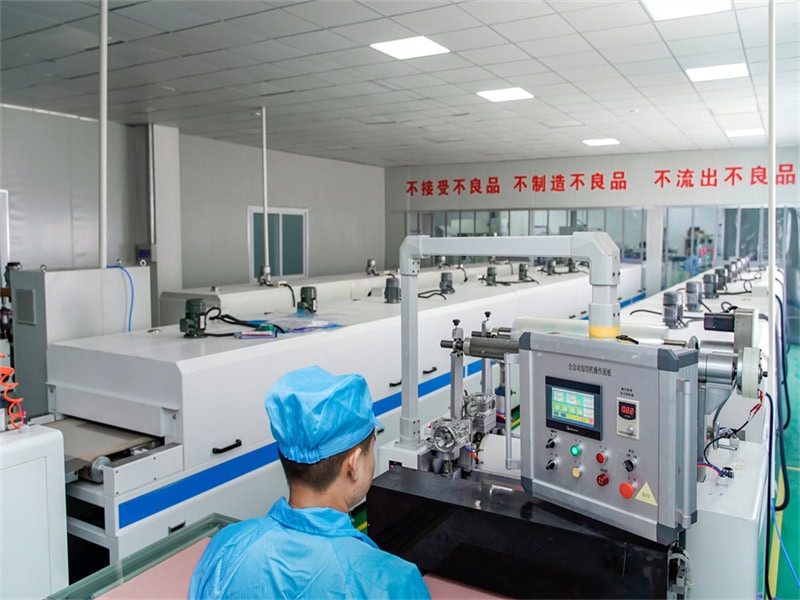
Field Engineering Integration: From initial spec to final NPI qualification. We work with your team to ensure the thermal numbers we hit in the lab survive the reality of your mass production line.
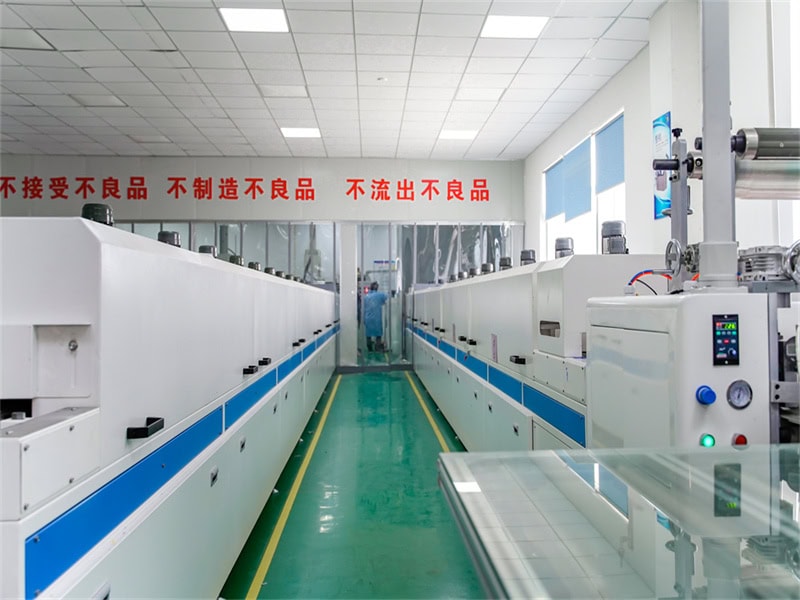
Relentless Consistency: Perfecting our own volume manufacturing to guarantee zero batch-to-batch variance. The millionth roll of PCM750 will hit the exact same thermal specs as the first sample you qualified.
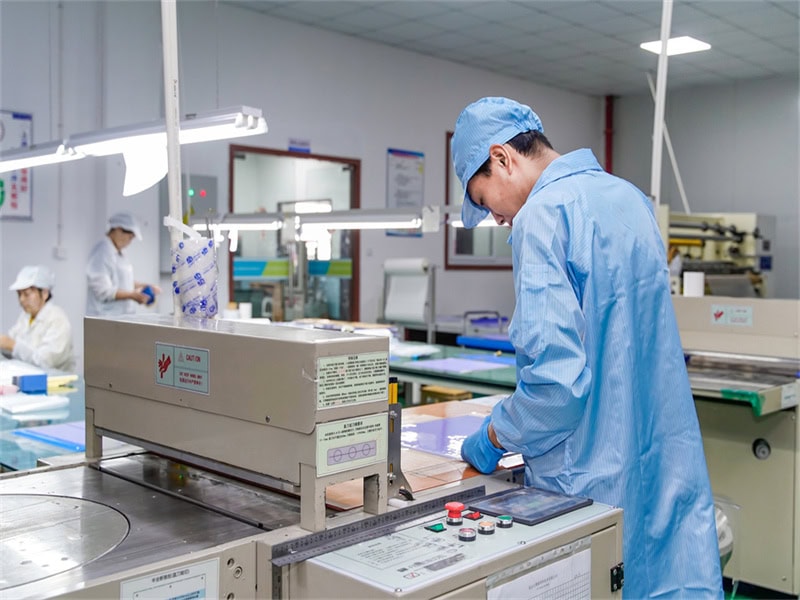
The Jiuju Conviction: Thermal management is no longer an afterthought. It is the absolute bottleneck. It alone dictates whether your hardware can survive today’s massive power demands—and whether it stays alive in the field.
That conviction is what PCM750 was built to express.
The Industry Direction Is Clear. So Is the Next Step.
Across AI, automotive, and 6G infrastructure, the underlying physics are identical: massive power, shrinking footprints, and zero tolerance for failure. This isn’t just a challenge—it’s the new baseline for electronics design.
Phase Change Materials aren’t just an alternative anymore—they are the new baseline for surviving this heat density.
When thermal engineers need a material that is lab-validated, field-proven, and production-ready, Jiuju PCM750 is the weapon of choice.
You have seen the specifications. You have seen the test data. You have seen the application scenarios.
The next step is straightforward.
Ready to Put PCM750 Into Your Thermal Design?
Request a sample and evaluate it in your actual assembly. Measure your own junction temperature results. Run it through your own qualification protocol. Let your test data — not ours — make the case.
Talk directly to our thermal engineers. If you’re fighting tight bondline constraints, brutal thermal cycling, custom geometries, or strict qualification standards, let’s hash out the exact details before you even pull a sample. We skip the sales pitch and get straight to the math.
Phase change materials are defining the future of thermal management.
PCM750 is ready to be part of your next design. And so is the Jiuju team behind it.