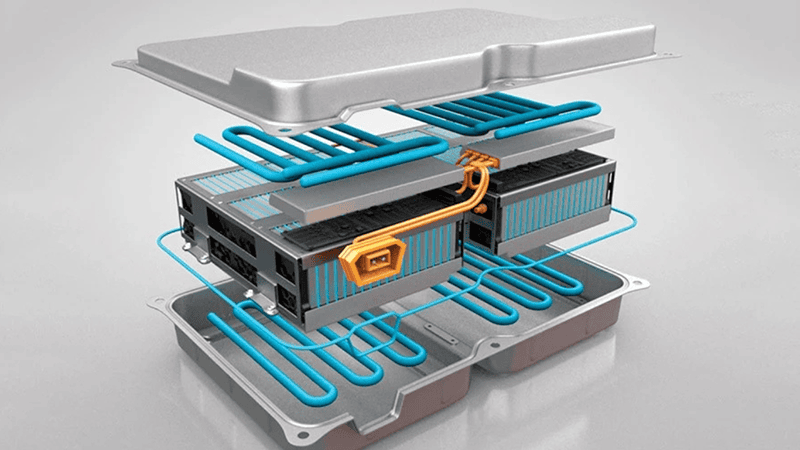
Thermal management is one big challenge engineers are facing today in high-power battery pack design. Especially, heat generated in EV battery modules is not managed properly, it can accelerate degradation, reduce charging speed, and even cause danger.
In fact, tests on EV battery modules have shown that poorly managed thermal resistance and air gaps between cooling systems can lead to temperature differences of 8–12 °C.
To address this thermal management issue, engineers or EV battery designers use thermal interface materials (TIMs) to effectively dissipate heat and ensure temperature uniformity. The following sections break down how you can systematically evaluate and choose the most suitable thermal interface material for your EV cooling system project.
The Core Role of Gap-Filling TIMs in Battery Thermal Management
When gap-filling TIMs are used to dissipate heat in advanced electric vehicle batteries, they play a core role in improving thermal performance, cooling capacity, safety, and reliability across modern electric vehicles’ cooling plates by:
Eliminating Air Gaps and Reducing Thermal Resistance

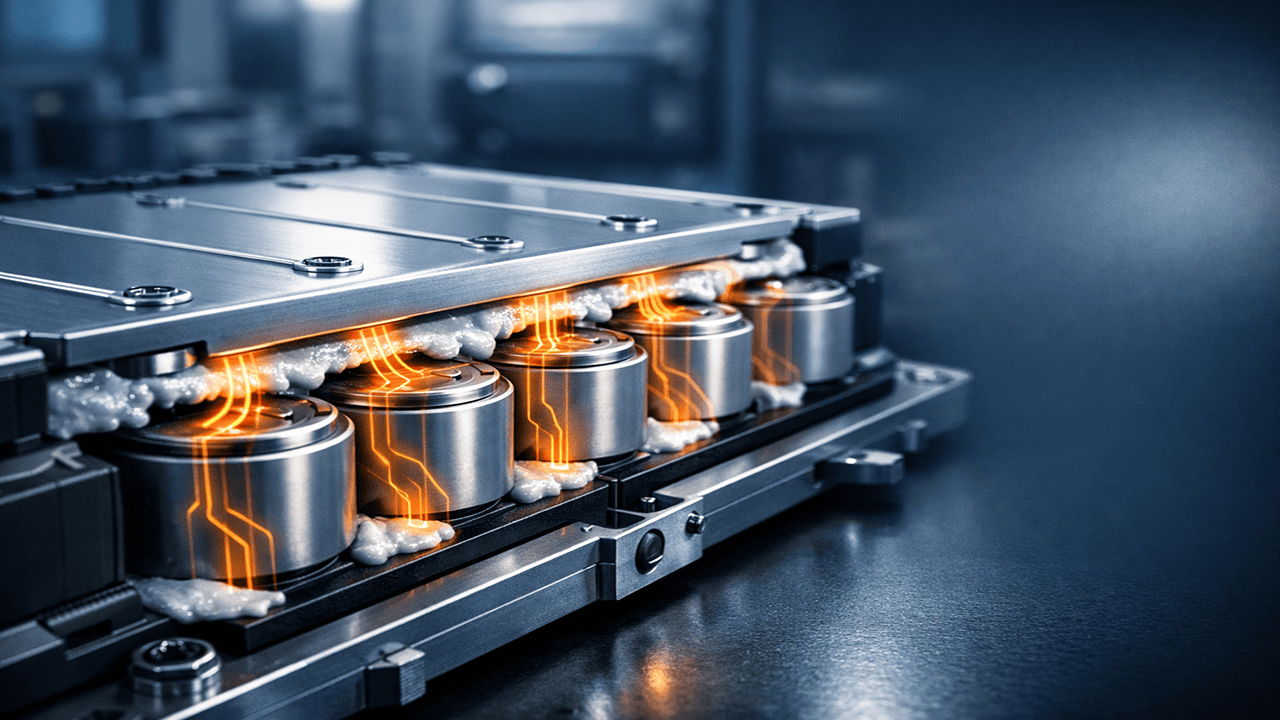
The core reason for poor thermal management in electric vehicle batteries is air gaps between battery cells and cooling plates (heat sink). Since air has low thermal conductivity, air gaps dissipate heat slowly inside the battery module or battery pack. As a result, heat accumulates inside the battery module and leads to temperature non-uniformity and then thermal runaway. However, when you apply TIMs inside battery assembly, they fill up those air gaps perfectly, improving thermal conductivity.
Creating a Stable Heat-Transfer Path
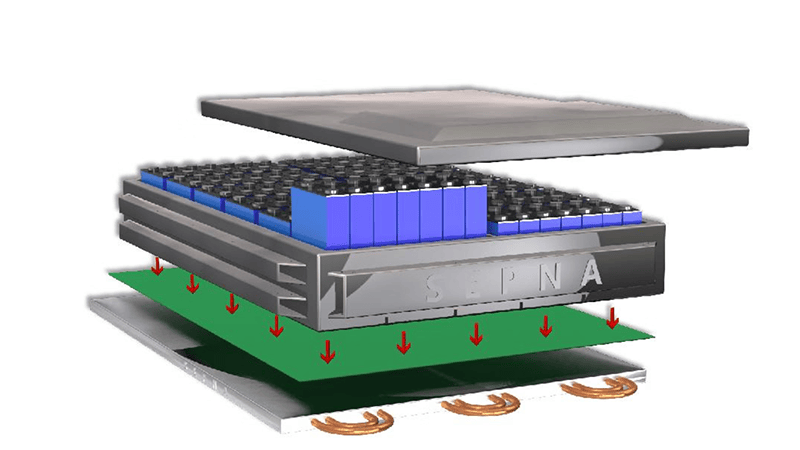
During assembly, gap fillers compress to conform to surface irregularities. When compressed, by filling air gaps, thermal interface material increases its real contact area with the cell and cooling plate surfaces. By doing so, material with lower thermal resistance ensures a faster heat transfer and cooling capacity. That’s how thermal interface materials create a stable transfer heat path, as shown in the picture below.

Ensuring Structural and Electrical Safety
Beyond heat dissipation, your thermal interface material selection also impacts safety in high-voltage battery assembly. Like most modern battery cooling systems operate at (≥800V). So in such cases, electrical energy (electrical insulation) and effective thermal management in cooling fins are extremely crucial.
Well-designed TIMs meet these requirements by offering dielectric strength. They also withstand many thermal cycles, carry heat, and have lower thermal impedance.
5 Key Performance Parameters of Gap Fillers Engineers Must Understand to Avoid Thermal Gap
For engineers like you, understanding thermal management in real-world electric vehicle conditions is important. Because under mechanical stress, vibration, and fast charging, li ion battery packs generate more heat.
So, poor thermal management inside batteries can lead to hot spots and uneven temperatures. And in worst cases, thermal runaway. That’s why selecting the right TIM is a core part of modern battery pack design. Below are the key parameters you must evaluate before finalizing a gap filler.
1. Thermal Conductivity (W/m·K)

You should select a material with high thermal conductive materials efficient heat transfer from battery components to the cooling system. Thermal conductivity, however, alone isn’t enough for stable thermal management.
If a TIM cannot conform to surface roughness, it creates air pockets, means reduced heat dissipation. This is especially crucial in battery pack design, where between cells and cooling plates, it is essential to maintain lower temperatures and prevent hot spots.
To achieve effective cooling capacity, you must evaluate thermal conductivity alongside compressibility.
2. Thermal Resistance (K·cm²/W)
Even if you select high thermal conductive TIM, it can fail if it introduces high thermal resistance. Because excess thickness reduces heat flow to the cooling plates.
So you must select TIM with low thermal resistance for the cooling system. This aids in maintaining lower temperatures and improving temperature uniformity. In fact, it even reduces the risk of thermal runaway in li ion battery packs.
3. Compression Rate & Rebound Characteristics
Manufacturing tolerances, cylindrical cells, prismatic cells, and pouch cells often create uneven gaps. So you must opt for advanced thermally conductive gap fillers with high compressibility to fill voids caused by mechanical stress and surface roughness.
Low rebound is, however, equally important. Because, in case a TIM loses contact after compression, vibration and thermal expansion reduce heat transfer to cooling plates. As a result, it can weaken thermal management in the long term and increase risk of hot spots inside battery components.
4. Electrical Insulation Properties
In high-voltage battery pack systems, electrical insulation is non-negotiable. So when selecting a TIM, you must consider several insulation properties. Like dielectric strength, breakdown voltage, and even volume resistivity.
Because non-combustible TIM prevents short circuits between battery components. These materials also ensures stable thermal management and air cooling.
5. Long-Term Reliability
Apart from all the above factors, you must ensure to select TIMs that can survive years of thermal cycling, humidity exposure, mechanical stresses, and vehicle operation stress. Reliable thermal management, hence, ensures consistent contact with cooling plates and long battery life.
Comparison of Common Gap-Filling Thermal Interface Material Types
Thermal Pads Gap Filler

Thermal pads are widely used in battery assembly design. They are solid, stable, clean, and easy to handle. Even their consistent thickness supports excellent thermal management and good contact with cooling plates. They are also compressible by 20-50%. You can use thermal pads to fill air gaps up to 0.5-5 mm, supplemented by air cooling.
Thermal Gels or Thermal Grease

Thermal gels or thermal grease are soft and flexible. They even conform well to surface roughness. By evenly filling gaps on heat source, they consistently dissipate heat to cooling plates.
These materials enhance thermal management in complex assembly process but require mechanical retention. You can use them in applications where air cooling in cylindrical cells is not sufficient.
Thermal Adhesives / Potting Compounds

Thermal adhesives and potting compounds contain both heat transfer and structural strength. Compared to other TIMs, they permanently bond cooling plates for robust thermal management. Their non-combustible nature improves safety and supports cooling systems. Limited reworkability, however, can be a drawback during repairs or redesigns.
Composite / Structured TIMs
Composite or structured TIMs combine both high thermal conductivity and controlled compressibility properties. They are ideal for high-power battery pack design for transfer heat faster. Especially where consistent heat flow to cooling plates is critical, and air cooling alone cannot handle peak loads.
A Practical Thermal Interface Material Workflow for Engineers
Material selection of thermal interface material (TIM) for EV battery is a structured engineering task in the automotive industry. In the below section, you’ll learn how you can practically make correct material selection for your needs.
Step 1: Measure Gap Size and Distribution
The first step is to accurately measure gaps between cells, cooling plates, and structural parts. To measure, you can use CMM measurement or laser scanning. Capturing correct data is essential for effective thermal management.
Step 2: Define Thermal Resistance Requirements
Next up, you need to define acceptable thermal limits based on system targets for additional protection. Most electric vehicle designers set ΔT targets (typically 2–5 °C) based on heat flux, charging rates, and liquid cooling system efficiency.
This step ensures the thermal interface material supports system-level thermal management and prevents hot spots during fast charging. Though keep in mind that correct targets help achieve lower thermal impedance.
Step 3: Choose the Material Category
Next up, select a material between pads, gels, or adhesives based on gap size, mechanical requirements, and battery pack design constraints. The goal is to maintain overall heat transfer to cooling plates under all operating conditions.
Step 4: Perform Compression Testing
In this step, you need to test thermal interface material behavior under real assembly loads. You need to evaluate how the material behaves under pressure and check spring-back after compression, to ensure long-term thermal management stability.
Step 5: Validate Thermal Performance
Finally, your team needs to perform hot-spot testing, fast-charging cycles, and aging tests. These tests help you confirm that the selected thermal interface material maintains heat flow, supports air cooling or liquid cooling systems, and prevents thermal runaway over time.
5 Common Mistakes in Thermal Interface Material Selection You Must Avoid
- Just relying on selecting material with high thermal conductivity. Whereas, ideal surface contact, electrical insulation, and material compatibility matter equally.
- Another issue is using rigid pads for large gaps created during the manufacturing process and assembly processes.
- Engineers also often ignore compression behavior and non-combustible properties. This often results in increased thermal resistance inside electronic components.
- Overlooking dielectric strength is another critical risk in high-voltage battery pack systems.
- Finally, not accounting for assembly tolerance stacking leads to poor thermal management.
Engineering Case Studies

Case 1: Thermal Pad Unable to Fill Irregular Gaps
Issue:
In this case, a standard thermal pad was selected for a battery interface with uneven surfaces.
What Happened:
Because thermal pads have limited compressibility, they cannot fully adapt to irregular gaps. And that results in a few air pockets left between the interface, increasing thermal resistance.
Our engineering recommendation:
Based on project requirements, we recommend Jiuju thermal pads offering thermal conductivity up to 1.0-30.0 W/m·K and 0.5–5 mm hardness.
Result:
Case 2 – Thermal Gel Reduces Temperature Gradient
Issue:
A battery module showed uneven temperatures due to irregular interfaces between cells and cooling components.
Our engineering recommendation:
We suggested using a thermal gel designed for better gap filling and surface conformity.
Result:
Conclusion
For selecting the right thermal interface material for an electric vehicle battery, you must consider thermal resistance, thermal conductivity, compression behavior, electrical insulation, and long-term reliability altogether. By matching material behavior to real gaps and operating conditions, you can select the suitable material.
Why Trust This guide
This guide is developed under the supervision of our engineering team at Jiuju, where we specialize in advanced thermal interface materials for electric vehicle battery modules. We have designed and produced more than 15 different thermal solutions, backed by real testing and application experience. The information shared here comes from practical engineering work, not theory alone. If you need help choosing the right material or evaluating your application, feel free to contact our technical team for expert support.