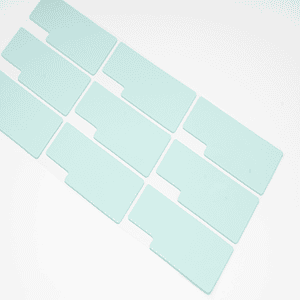
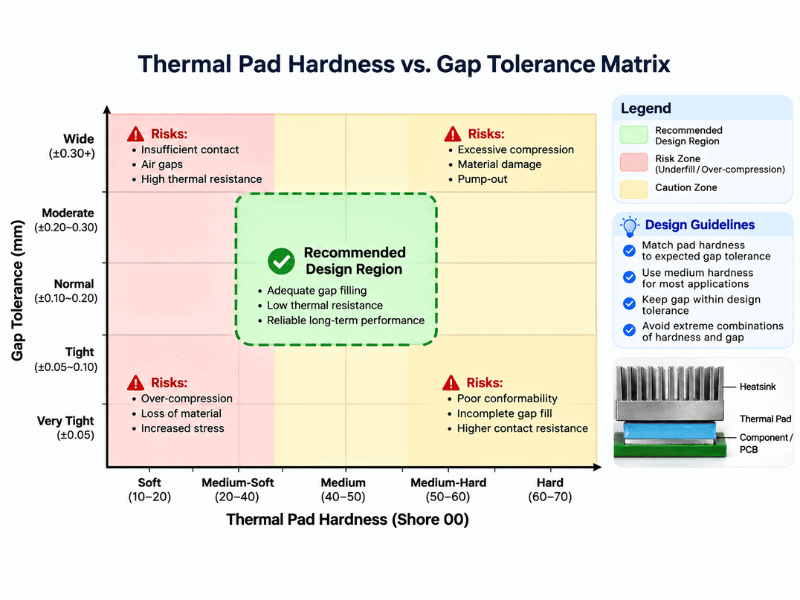
Thermal pad hardness affects how easily a pad conforms to uneven surfaces and how much force it may apply when compressed. A softer pad can often tolerate a wider gap variation at lower assembly load. A harder pad may need a more precise thickness match and a stiffer load path.
Hardness does not determine thickness by itself. It narrows the compression window you can safely use.
Confirm the durometer scale first
Thermal pads are commonly soft enough to use the Shore 00 scale. Shore A is much harder and the numerical values are not interchangeable.
Jiuju identifies its thermal-pad hardness values as Shore 00. Its public thermal pad specifications show standard grades spanning soft constructions and higher-hardness options.
ASTM D2240 is the standard test method for rubber durometer hardness. A durometer value describes resistance to indentation under the stated method. It does not directly provide the pressure required to compress a full pad area.

Why the same thickness behaves differently by hardness
Imagine two 1.5 mm pads in a 1.2 mm gap. Both see 20% geometric compression.
- A softer pad may conform to surface waviness and reach full contact at modest pressure.
- A harder pad may push strongly on the tallest points before filling low regions.
The geometry is identical. The force distribution is not.
The difference becomes more important as contact area and surface variation grow. On a wide or slightly bowed interface, a harder pad may load the high regions before it reaches the low regions. A softer pad may conform more readily, but it can also shift or extrude if the design lacks lateral support. Do not convert package size into a fixed hardness rule; use the measured gap map and the exact grade’s pressure-deflection curve.
That difference affects:
- PCB bow
- Package stress
- Fastener seating
- Contact area
- Cooler tilt
- Handling and placement
- Long-term relaxation
Soft thermal pads: strengths and limits
Advantages
- Conform to rough or uneven surfaces
- Need less load to establish contact
- Accommodate mixed component heights
- Reduce local stress on fragile packages
Tradeoffs
- Can stretch, wrinkle, or tear during handling
- May require a carrier or liner for automated assembly
- Can shift or extrude if poorly constrained
- Some silicone formulations may need low-bleed screening for sensitive environments
A soft pad is not permission to ignore thickness. Excess material can still lift a cooler or create a long heat path.
Harder thermal pads: strengths and limits
Advantages
- Easier handling and die cutting
- Better dimensional stability
- Potentially better resistance to lateral movement
- Reinforced grades can suit demanding assembly processes
Tradeoffs
- Higher load for the same strain may be required
- Less ability to conform to waviness
- Tighter gap and thickness tolerance may be needed
- Tall components can carry disproportionate force
Use harder pads where the assembly has controlled flatness and a deliberate load path—not merely because they feel easier to install.
Hardness versus conductivity
Increasing thermally conductive filler can change hardness and compression response. Jiuju reports its high-conductivity 8–25 W/m·K thermal-pad group at 40–60 Shore 00, while noting that exact behavior depends on the grade.
Do not infer pressure from that range. Request:
- Shore 00 test method and specimen construction
- Compression stress versus strain curve
- Thermal impedance versus pressure or thickness
- Pad thickness tolerance
- Reinforcement and adhesive details
ASTM D575 provides a standard basis for comparing rubber compression-deflection characteristics. ASTM D5470 provides the thermal-impedance context.
Hardness testing and compression testing answer different questions
A Shore 00 durometer presses a defined indenter into the surface. The reading is affected by specimen thickness, support surface, dwell and test method. A compression tester loads a wider area and records stress or force versus displacement. That response is much closer to what a lid, cold plate or heat sink experiences.
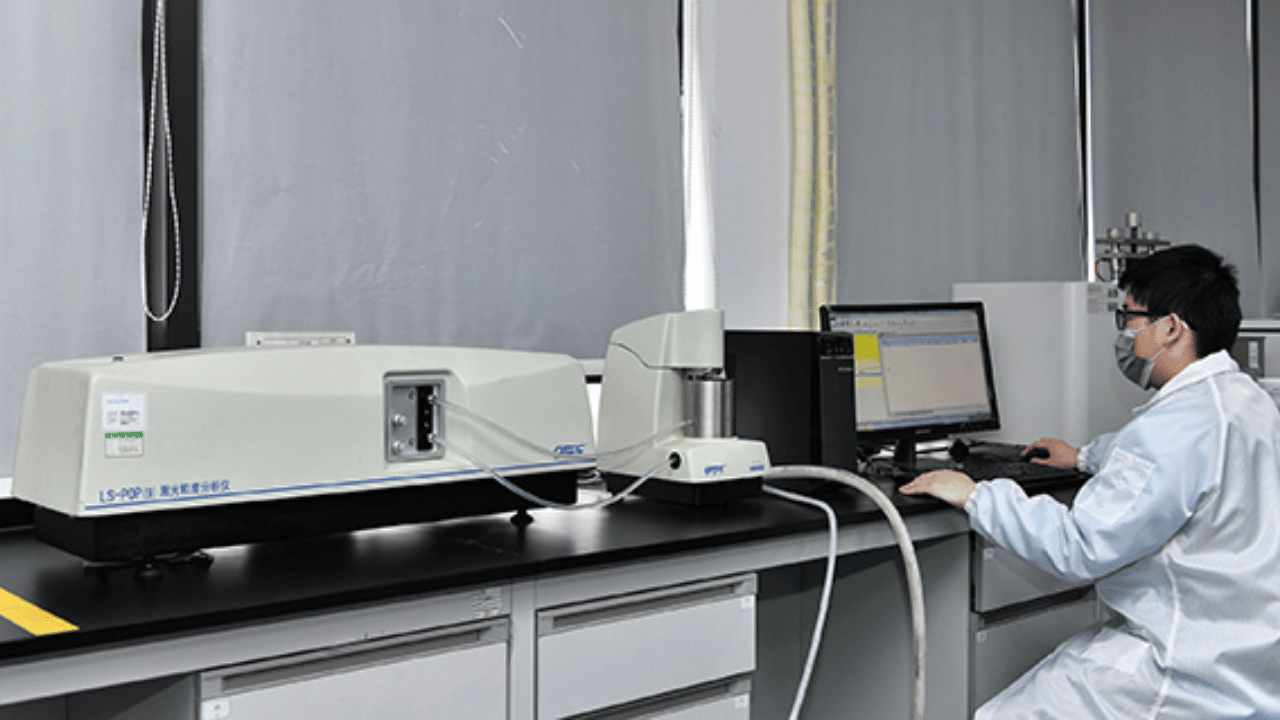
Jiuju’s documented laboratory equipment includes both a Shore 00 durometer and a rapid compression tester. For selection, use the durometer result as one material-verification and lot-consistency check; it cannot confirm material identity by itself. Use the compression curve to calculate the load at the minimum-gap condition.
When reviewing a curve, confirm:
- Exact grade, pad thickness and number of layers
- Specimen area and platen geometry
- Test temperature and compression speed
- Whether data shows initial loading, unloading or a later cycle
- Dwell time before the force reading
- Engineering stress versus total force units
Do not scale total force from a supplier coupon directly unless you convert it to pressure first. Then multiply by the real contact area and check how the pads are distributed around the fasteners and supports.
What can make hardness drift between lots
Formulation and process variation can affect both indentation and bulk response. Jiuju documents incoming checks for filler D10/D50/D90 particle-size points, mixed viscosity and volatile content. Candidate filler families and their surface treatment vary with the conductivity target. These controls help manage dispersion and process consistency, but the finished-pad checks still matter.
For a thickness-and-hardness critical design, define at least:
- Thickness tolerance and the controlled-force measurement method.
- Shore 00 target, specimen stack and dwell.
- Compression stress at one or more design strains.
- Thermal impedance at a relevant thickness and pressure.
- Post-aging or post-cycling change limits where reliability requires them.
If an incoming lot meets Shore 00 but produces a different assembly load, investigate thickness, reinforcement, adhesive, compression rate and formulation records. Hardness alone is not enough evidence to approve substitution.
How to select thickness with hardness data
- Measure minimum and maximum assembly gaps.
- Choose candidate nominal thicknesses using the formula in the pillar guide.
- Calculate compression extremes with pad tolerance included.
- Read pressure from the exact grade’s compression curve.
- Multiply pressure by contact area to estimate total force.
- Check component, PCB, fastener, and enclosure limits.
- Inspect witness marks and seating on several assemblies.
- Run controlled thermal and reliability tests.
If a hard pad exceeds the force budget, you can reduce thickness, tighten the gap tolerance, select a softer formulation, segment the pad area, or redesign the support structure.
For a large interface, review the contact print by zone instead of recording only “pass” or “fail.” Mark where contact begins, where the pad reaches maximum strain, and where the cooler or board deflects. This separates a conformity problem from a nominal-thickness problem and gives the supplier a usable target for hardness and compression-force screening.
Common mistakes
- Writing “50 Shore” without stating 00, A, or another scale
- Treating hardness as a compression-force curve
- Substituting a harder high-conductivity grade at the same thickness
- Ignoring reinforcement and adhesive layers
- Testing one flat coupon and assuming a large warped assembly behaves the same
- Selecting softness without considering handling and automation
FAQ
Is a lower Shore 00 value always better?
No. Softer pads improve conformity but can be harder to handle and constrain. Select the lowest force that meets thermal, process, and reliability needs.
Can two pads with the same Shore 00 value be direct substitutes?
Not automatically. Their compression curves, conductivity, reinforcement, thickness tolerance, electrical properties, and aging behavior may differ.
Does a softer pad need to be thicker?
Not by definition. Thickness comes from the gap. Softness determines how the material conforms and what force it develops within the required thickness range.
Use hardness to predict fit—not performance alone
Thermal pad hardness is most useful when combined with thickness, pressure, and surface geometry. Confirm the scale, obtain the compression curve, and calculate total force before substituting grades.
For candidate data, review Jiuju’s thermal pad specification table and send the gap range and load limit when requesting a recommendation.